o3 vs Magistral Medium
Benchmarks, API Token Pricing, Context Window & Speed Comparison
Related topics (12)
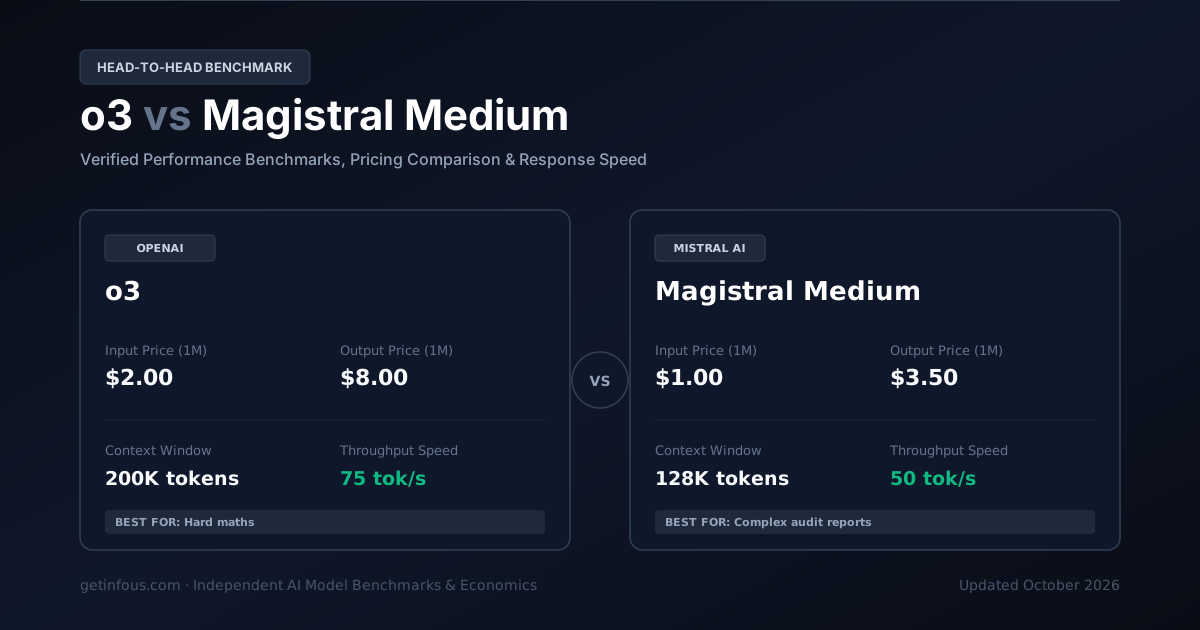
o3 de OpenAI et Magistral Medium de Mistral AI sont deux modèles d’IA de premier plan. o3 propose une fenêtre de contexte de 200K tokens au tarif de $2.00/$8.00 par million de tokens, tandis que Magistral Medium offre 128K tokens de contexte à $1.00/$3.50 par million de tokens. Découvrez ci-dessous le comparatif détaillé des performances et des coûts.
Changez et Comparez les Modèles
Select any AI models from our verified benchmark database to generate live side-by-side matrices.
o3
Moteur de Raisonnement Profondo3 de OpenAI est un modèle d’IA conçu pour le raisonnement logique profond, les mathématiques formelles et l’analyse scientifique, offrant une fenêtre de contexte de 200K, une vitesse de 75 tokens/s, un indice d’intelligence de 56/100 et un
$2.00 / 1M
$8.00 / 1M
200K tokens
69.1%
Magistral Medium
Moteur de Raisonnement ProfondMagistral Medium de Mistral AI est un modèle d’IA conçu pour le raisonnement logique profond, les mathématiques formelles et l’analyse scientifique, offrant une fenêtre de contexte de 128K, une vitesse de 50 tokens/s, un indice d’intelligen
$1.00 / 1M
$3.50 / 1M
128K tokens
45.2%
Différences Clés en un Coup d’Œil
- Magistral Medium is 2.2x cheaper for API usage (input + output tokens combined).
- o3 has a larger context window (200K vs 128K tokens).
- o3 is faster at 75 tok/s vs 50 tok/s.
- o3 leads on SWE-bench coding (69.1% vs 45.2%).
| Caractéristique | o3 | Magistral Medium |
|---|---|---|
Intelligence Index Composite reasoning & knowledge score (0-100) | 56 | 51 |
Provider | OpenAI | Mistral AI |
Input Price Cost per million input tokens | $2.00 / 1M | $1.00 / 1M |
Output Price Cost per million output tokens | $8.00 / 1M | $3.50 / 1M |
Blended Price Weighted 7:2:1 cache:input:output per 1M | $1.55 / 1M | $0.72 / 1M |
Context Window Maximum input + output tokens | 200K tokens~300 A4 pages of text | 128K tokens~192 A4 pages of text |
Max Output Tokens Per single request | 100K | 33K |
Throughput Speed Tokens generated per second | 75 tok/s | 50 tok/s |
SWE-bench Verified Real-world software engineering | 69.1% | 45.2% |
GPQA Diamond Graduate-level reasoning | 76.5% | 67.8% |
Cached Input Price Prompt caching discount per 1M tokens | $0.50 / 1M | $0.25 / 1M |
Qui gagne où ?
At-a-glance decision frameworkScores de Benchmarks Vérifiés
Official evaluation metrics verified by independent third-party research labs.
Industry benchmark evaluating real-world GitHub issue resolution and multi-file debugging.
Challenging questions created by domain experts to test complex PhD-level reasoning.
Hardened reasoning and academic knowledge benchmark with reduced lucky-guess probability.
Crowdsourced human preference evaluation based on blind, head-to-head model battles.
Extremely difficult, closed-ended questions spanning the frontier of human expert knowledge.
Autonomous multi-step tasks executed inside a real command-line terminal environment.
Research-grade coding problems drawn from real scientific and numerical workloads.
Contamination-free competitive programming problems collected continuously over time.
American Invitational Mathematics Examination — multi-step Olympiad-level reasoning.
Accuracy when reasoning over very large inputs that fill the model context window.
Tokens emitted per second during active generation streaming.
Latence et Temps de Réponse
Time to first token (TTFT) and estimated end-to-end response time for a typical 500-token response.
Simulateur Interactif de Coût de Tokens
Adjust sliders to calculate projected monthly cloud API spending with prompt caching discounts.
o3 · Strengths & Key Advantages
- Fenêtre de contexte de 200K et capacité de sortie maximale de 100K tokens (SWE-bench Verified 69.1% · GPQA Diamond 76.5%)
- Débit rapide de 75 tokens/seconde avec une latence au premier token (TTFT) de 2800 ms
- Tarification API optimisée ($2/$8 par million de tokens) avec prise en charge du cache de prompts et des schémas JSON stricts
Considerations & Trade-offs
- Modèle cloud propriétaire ne permettant pas le téléchargement local des poids sur serveur isolé
- Pour les charges à très fort volume, l’activation du cache de prompts et de l’API Batch est recommandée
Magistral Medium · Strengths & Key Advantages
- Fenêtre de contexte de 128K et capacité de sortie maximale de 33K tokens (SWE-bench Verified 45.2% · GPQA Diamond 67.8%)
- Débit rapide de 50 tokens/seconde avec une latence au premier token (TTFT) de 850 ms
- Tarification API optimisée ($1/$3.5 par million de tokens) avec prise en charge du cache de prompts et des schémas JSON stricts
Considerations & Trade-offs
- Modèle cloud propriétaire ne permettant pas le téléchargement local des poids sur serveur isolé
- Sur les problèmes de recherche fondamentale très complexes, les modèles de raisonnement lourd restent supérieurs
Token Use & Task Economics
Estimated cost and token consumption to complete one representative agentic task.
| Metric | o3 | Magistral Medium |
|---|---|---|
Cost per Task Estimated USD to finish one task | $1.35 | $0.65 |
Output Tokens / Task Tokens generated per task | 48K | 40K |
Reasoning Tokens / Task Thinking tokens burned per task | 26K | 22K |
Spécifications Techniques
Architecture, release timeline, capabilities, and modalities.
| Caractéristique | o3 | Magistral Medium |
|---|---|---|
| Official API Model ID (SDK) | o3 | magistral-medium-latest |
| API Protocol | OpenAI Responses API & Chat Completions v1 | Mistral AI REST API (OpenAI-Compatible) |
| Release Date | 2025-04 | 2025-03 |
| Knowledge Cutoff | June 2024 | January 2025 |
| Architecture | Reasoning transformer with adjustable thinking effort | Reinforcement-Learned Reasoning Transformer |
| Parameters | Confidential | Confidential (~70B) |
| Enterprise Rate Limits (RPM / TPM) | 10,000 – 30,000 RPM (Tier 5 Enterprise) · 800,000 – 2,000,000 TPM | 5,000 – 15,000 RPM (Production Tier) · 800,000 – 2,000,000 TPM |
| Long-Context Tier (>128K/200K) | Flat rate ($2/1M in) across full 200K window | Flat rate ($1/1M in) across full 128K window |
| Prompt Cache Policy & TTL | Automatic prefix caching at $0.5/1M (no extra cache-write fee) | Cached input at $0.25/1M tokens |
| Computer Use / GUI Agent | Supported (Screen coordinate grounding, browser & desktop GUI action loops) | API / CLI Tool-Use & DOM Agent ready (no raw pixel desktop click loop) |
| MCP & Parallel Tool Calling | Native MCP Client/Server ready · Parallel function calling · 100% Strict JSON Schema | Native MCP Client/Server ready · Parallel function calling · 100% Strict JSON Schema |
| Web Search Grounding & Sandbox | Native Web Search tool + Hosted Code Interpreter & File Search RAG | Supported via external Tavily/Exa Search & E2B/Docker Sandbox tools |
| Official Fine-Tuning Support | Supervised Fine-Tuning (SFT), Direct Preference (DPO) & Reinforcement Fine-Tuning (RFT) | API Prompt Engineering & RAG Distillation |
| Multimodal Token Billing | Text BPE (~4 chars/token) · Vision (~258–765 tokens per image tile) | Text BPE (~4 chars/token) |
| Quantization & Min GPU VRAM | Cloud-Hosted Proprietary (FP8 / BF16 Tensor Core Cluster) · Zero Local VRAM Required (100% Serverless Cloud API) | Cloud-Hosted Proprietary (FP8 / BF16 Tensor Core Cluster) · Zero Local VRAM Required (100% Serverless Cloud API) |
| Safety & Frontier Classification | OpenAI Preparedness Framework Audited & System Card Published | Mistral AI Production Safety & Alignment Verified |
| Enterprise Compliance (ZDR/HIPAA/SOC2) | SOC2 Type II · GDPR · Zero Data Retention (ZDR) & HIPAA BAA Available on Enterprise Tier | SOC2 Type II · GDPR · Zero Data Retention (ZDR) & HIPAA BAA Available on Enterprise Tier |
| Input Modalities | text, vision | text |
| Output Modalities | text | text |
o3 vs Magistral Medium: Réponses Rapides (FAQ)
Which is more intelligent, o3 or Magistral Medium?
o3 is more intelligent. It scores 56 compared with 51 on the composite Intelligence Index.
Which model is faster?
o3 is faster, generating 75 tokens per second compared with 50 tokens per second.
Which model is cheaper to run?
Magistral Medium is cheaper at $0.72 per 1M tokens blended, compared with $1.55 (7:2:1 cache:input:output ratio).
Which model has lower latency?
Magistral Medium has lower latency, with a time to first token of 0.85s compared with 2.80s.
Which model has a larger context window?
o3 has a larger context window, supporting 200K tokens compared with 128K tokens.
Verdict
o3 (Conçu pour le raisonnement logique profond, les mathématiques formelles et l’analyse scientifique, l’intégration RAG et les pipelines de production évolutifs.) et Magistral Medium (Conçu pour le raisonnement logique profond, les mathématiques formelles et l’analyse scientifique, l’intégration RAG et les pipelines de production évolutifs.) répondent à des besoins complémentaires : o3 domine sur les benchmarks de raisonnement et de programmation, o3 assure un débit supérieur et Magistral Medium offre le meilleur rapport coût-efficacité en production.
Questions fréquentes
Quel modèle choisir pour le code et le raisonnement, o3 ou Magistral Medium ?+
Sur l’indice d’intelligence composite et les tests de code, o3 prend l’avantage. Consultez les scores SWE-bench et GPQA ci-dessus pour plus de détails.
Quelle est la différence de prix API entre o3 et Magistral Medium ?+
o3 est facturé $2.00 / $8.00 par million de tokens (entrée/sortie) contre $1.00 / $3.50 pour Magistral Medium. En coût pondéré, Magistral Medium est plus économique.
Quel modèle offre la plus grande fenêtre de contexte et la meilleure vitesse ?+
o3 prend en charge 200K tokens contre 128K tokens pour Magistral Medium. Côté vitesse de génération, o3 est le plus rapide.
Understand key metrics like context window, token pricing, reasoning mode, and SWE-bench scores in our comprehensive AI glossary.
Related reading
- Command A Reasoning vs o3 : Comparatif Benchmarks, Tarifs API et Vitesse (2026)Comparer
- Grok 4.20 (Reasoning) vs o3 : Comparatif Benchmarks, Tarifs API et Vitesse (2026)Comparer
- Magistral Medium vs ERNIE 4.5 : Comparatif Benchmarks, Tarifs API et Vitesse (2026)Comparer
- OpenAI o1 vs o3 : Comparatif Benchmarks, Tarifs API et Vitesse (2026)Comparer
- o3 vs Claude Opus 4.5 : Comparatif Benchmarks, Tarifs API et Vitesse (2026)Comparer
- o3 vs DeepSeek-R1-0528 : Comparatif Benchmarks, Tarifs API et Vitesse (2026)Comparer
Les scores de benchmarks, tarifs par token et limites évoluent rapidement. Vérifiez toujours les spécifications actuelles sur la documentation officielle du fournisseur.
Sources: Documentation API officielle de OpenAI et Mistral AI, fiches système et benchmarks indépendants (2026).