Hy3 vs Kimi K2.7 Code
Benchmarks, API Token Pricing, Context Window & Speed Comparison
Related topics (12)
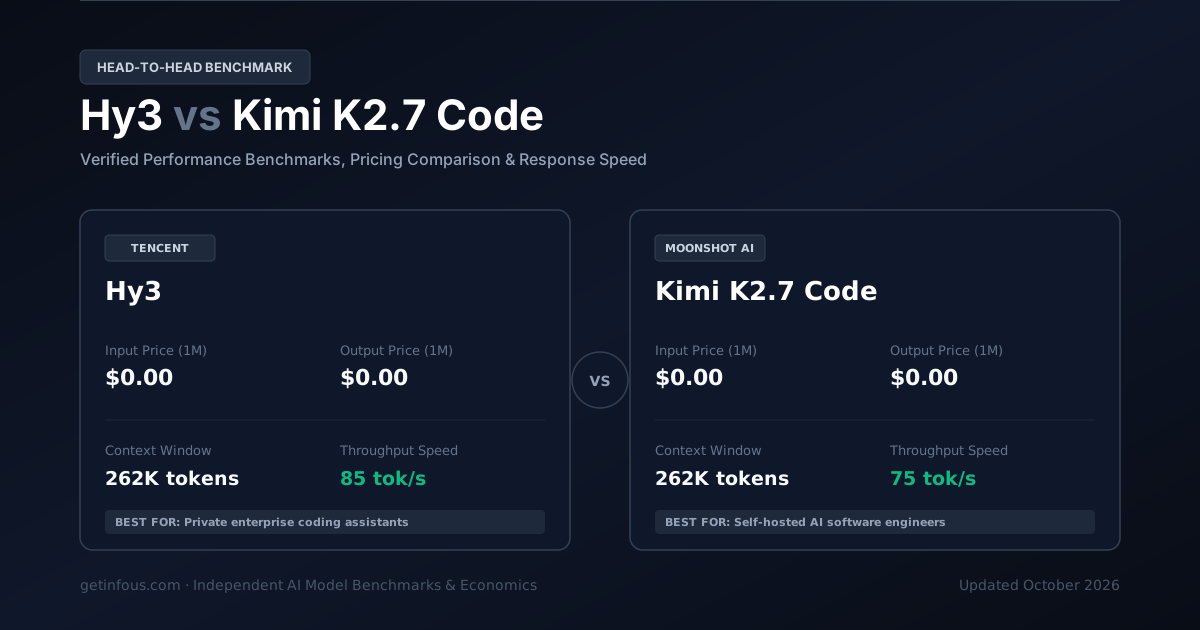
Hy3 de Tencent y Kimi K2.7 Code de Moonshot AI compiten directamente en el ecosistema actual de IA. Hy3 ofrece una ventana de contexto de 262.1K tokens a $0.00/$0.00 por millón de tokens (entrada/salida), mientras que Kimi K2.7 Code ofrece 262.1K tokens de contexto a $0.00/$0.00 por millón de tokens. Analizamos sus benchmarks, latencia y costos reales.
Cambia y Compara Cualquier Modelo
Select any AI models from our verified benchmark database to generate live side-by-side matrices.
Hy3
Razonamiento de Pesos AbiertosHy3 de Tencent es un modelo de IA diseñado para razonamiento de cadena de pensamiento con pesos abiertos y alta eficiencia algorítmica, con ventana de contexto de 262K, velocidad de 85 tokens/s, índice de inteligencia de 81/100 y tarifa de
$0.00 / 1M
$0.00 / 1M
262.1K tokens
N/A
Kimi K2.7 Code
Especialista Abierto en CódigoKimi K2.7 Code de Moonshot AI es un modelo de IA diseñado para desarrollo de software y generación de código con pesos abiertos autoalojables, con ventana de contexto de 262K, velocidad de 75 tokens/s, índice de inteligencia de 89/100 y tar
$0.00 / 1M
$0.00 / 1M
262.1K tokens
62%
Diferencias Clave de un Vistazo
- Both models cost the same under this workload — choose on capability, not price.
- Hy3 is faster at 85 tok/s vs 75 tok/s.
| Característica | Hy3 | Kimi K2.7 Code |
|---|---|---|
Intelligence Index Composite reasoning & knowledge score (0-100) | 81 | 89 |
Provider | Tencent | Moonshot AI |
Input Price Cost per million input tokens | $0.00 / 1M | $0.00 / 1M |
Output Price Cost per million output tokens | $0.00 / 1M | $0.00 / 1M |
Blended Price Weighted 7:2:1 cache:input:output per 1M | $0.00 / 1M | $0.00 / 1M |
Context Window Maximum input + output tokens | 262.1K tokens~393 A4 pages of text | 262.1K tokens~393 A4 pages of text |
Max Output Tokens Per single request | 16K | 32K |
Throughput Speed Tokens generated per second | 85 tok/s | 75 tok/s |
SWE-bench Verified Real-world software engineering | N/A | 62% |
GPQA Diamond Graduate-level reasoning | 64% | 73% |
¿Quién gana en cada área?
At-a-glance decision frameworkEvaluations ongoing
Puntuaciones de Benchmarks Verificadas
Official evaluation metrics verified by independent third-party research labs.
Industry benchmark evaluating real-world GitHub issue resolution and multi-file debugging.
Challenging questions created by domain experts to test complex PhD-level reasoning.
Hardened reasoning and academic knowledge benchmark with reduced lucky-guess probability.
Crowdsourced human preference evaluation based on blind, head-to-head model battles.
Contamination-free competitive programming problems collected continuously over time.
Tokens emitted per second during active generation streaming.
Latencia y Tiempo de Respuesta
Time to first token (TTFT) and estimated end-to-end response time for a typical 500-token response.
Simulador Interactivo de Costos de Tokens
Adjust sliders to calculate projected monthly cloud API spending with prompt caching discounts.
Hy3 · Strengths & Key Advantages
- Ventana de contexto de 262K con hasta 16K tokens de salida máxima (GPQA Diamond 64% · MMLU-Pro 79%)
- Rendimiento ágil de 85 tokens/segundo con latencia inicial (TTFT) de solo 460 ms
- Pesos abiertos (Confidential / 140B MoE) listos para autoalojamiento local o en nube privada mediante vLLM y Ollama
Considerations & Trade-offs
- Requiere infraestructura GPU dedicada con suficiente memoria VRAM para inferencia local sin cuantización
- En demostraciones científicas extremas, los modelos de razonamiento pesado de gama alta ofrecen mayor profundidad
Kimi K2.7 Code · Strengths & Key Advantages
- Ventana de contexto de 262K con hasta 32K tokens de salida máxima (SWE-bench Verified 62% · GPQA Diamond 73%)
- Rendimiento ágil de 75 tokens/segundo con latencia inicial (TTFT) de solo 480 ms
- Pesos abiertos (1.5T total (40B MoE)) listos para autoalojamiento local o en nube privada mediante vLLM y Ollama
Considerations & Trade-offs
- Requiere infraestructura GPU dedicada con suficiente memoria VRAM para inferencia local sin cuantización
- En demostraciones científicas extremas, los modelos de razonamiento pesado de gama alta ofrecen mayor profundidad
Token Use & Task Economics
Estimated cost and token consumption to complete one representative agentic task.
| Metric | Hy3 | Kimi K2.7 Code |
|---|---|---|
Cost per Task Estimated USD to finish one task | $0.00 | $0.00 |
Output Tokens / Task Tokens generated per task | 18K | 26K |
Reasoning Tokens / Task Thinking tokens burned per task | 5K | 5K |
Especificaciones Técnicas
Architecture, release timeline, capabilities, and modalities.
| Característica | Hy3 | Kimi K2.7 Code |
|---|---|---|
| Official API Model ID (SDK) | hy3 | kimi-k2-7-code |
| API Protocol | OpenAI-Compatible REST / vLLM / SGLang / HuggingFace TGI | OpenAI-Compatible REST / vLLM / SGLang / HuggingFace TGI |
| Release Date | 2026-07 | 2026-06 |
| Knowledge Cutoff | April 2026 | April 2026 |
| Architecture | Efficient Open Reasoning MoE Transformer | Code-Optimized Sparse Mixture-of-Experts Transformer |
| Parameters | Confidential / 140B MoE | 1.5T total (40B active MoE) |
| Enterprise Rate Limits (RPM / TPM) | Unlimited (Hardware-bound on self-hosted GPU) / 10,000 RPM Cloud · Unlimited local throughput / 10M+ TPM Managed Cloud | Unlimited (Hardware-bound on self-hosted GPU) / 10,000 RPM Cloud · Unlimited local throughput / 10M+ TPM Managed Cloud |
| Long-Context Tier (>128K/200K) | Free across full context window (only KV-cache VRAM scales) | Free across full context window (only KV-cache VRAM scales) |
| Prompt Cache Policy & TTL | Automatic prefix KV-caching in vLLM / SGLang (0 cost) | Automatic prefix KV-caching in vLLM / SGLang (0 cost) |
| Computer Use / GUI Agent | API / CLI Tool-Use & DOM Agent ready (no raw pixel desktop click loop) | Supported (Screen coordinate grounding, browser & desktop GUI action loops) |
| MCP & Parallel Tool Calling | Native MCP Client/Server ready · Parallel function calling · 100% Strict JSON Schema | Native MCP Client/Server ready · Parallel function calling · 100% Strict JSON Schema |
| Web Search Grounding & Sandbox | Supported via external Tavily/Exa Search & E2B/Docker Sandbox tools | Supported via external Tavily/Exa Search & E2B/Docker Sandbox tools |
| Official Fine-Tuning Support | Full Weights SFT, LoRA, QLoRA, DPO & GRPO RL (Unsloth / Axolotl / Llama-Factory) | Full Weights SFT, LoRA, QLoRA, DPO & GRPO RL (Unsloth / Axolotl / Llama-Factory) |
| Multimodal Token Billing | Text BPE (~4 chars/token) | Text BPE (~4 chars/token) · Vision (~258–765 tokens per image tile) |
| Quantization & Min GPU VRAM | BF16 / FP16, FP8 Dynamic, INT4 AWQ / GPTQ, GGUF (Q4_K_M / Q8_0) · 87 GB VRAM (4-bit Quantized) · 301 GB VRAM (Native BF16) | BF16 / FP16, FP8 Dynamic, INT4 AWQ / GPTQ, GGUF (Q4_K_M / Q8_0) · 930 GB VRAM (4-bit Quantized) · 3225 GB VRAM (Native BF16) |
| Safety & Frontier Classification | Open-Weights System Card + Customizable Guardrail Layer (Llama Guard / ShieldGemma) | Open-Weights System Card + Customizable Guardrail Layer (Llama Guard / ShieldGemma) |
| Enterprise Compliance (ZDR/HIPAA/SOC2) | 100% Air-Gapped On-Premises / Private VPC · Full HIPAA, GDPR & SOC2 Control | 100% Air-Gapped On-Premises / Private VPC · Full HIPAA, GDPR & SOC2 Control |
| Input Modalities | text | text, vision |
| Output Modalities | text | text |
Hy3 vs Kimi K2.7 Code: Respuestas Rápidas (FAQ)
Which is more intelligent, Hy3 or Kimi K2.7 Code?
Kimi K2.7 Code is more intelligent. It scores 89 compared with 81 on the composite Intelligence Index.
Which model is faster?
Hy3 is faster, generating 85 tokens per second compared with 75 tokens per second.
Which model has lower latency?
Hy3 has lower latency, with a time to first token of 0.46s compared with 0.48s.
Veredicto
Tanto Hy3 (Ideal para razonamiento de cadena de pensamiento con pesos abiertos y alta eficiencia algorítmica, sistemas RAG empresariales y automatización mediante API.) como Kimi K2.7 Code (Ideal para desarrollo de software y generación de código con pesos abiertos autoalojables, sistemas RAG empresariales y automatización mediante API.) destacan en producción: Kimi K2.7 Code lidera en inteligencia general y programación, Hy3 ofrece mayor velocidad de generación de tokens y Hy3 resulta más rentable para cargas de trabajo API de alto volumen.
Preguntas frecuentes
¿Cuál es mejor para programación y razonamiento, Hy3 o Kimi K2.7 Code?+
En las pruebas de inteligencia compuesta y resolución de código, Kimi K2.7 Code obtiene la ventaja. Puedes revisar la tabla SWE-bench y GPQA arriba para comparar cada métrica.
¿Cuánto cuesta la API de Hy3 frente a Kimi K2.7 Code?+
Hy3 cuesta $0.00 / $0.00 por millón de tokens de entrada/salida, mientras que Kimi K2.7 Code cuesta $0.00 / $0.00. En costo combinado, Hy3 es la opción más económica.
¿Qué modelo tiene mayor ventana de contexto y menor latencia?+
Hy3 cuenta con 262.1K tokens de contexto frente a 262.1K tokens de Kimi K2.7 Code. En velocidad de inferencia, Hy3 ofrece un rendimiento superior.
Understand key metrics like context window, token pricing, reasoning mode, and SWE-bench scores in our comprehensive AI glossary.
Related reading
- Hy3 vs. Hy3 preview: Comparativa de Benchmarks, Precios API y Velocidad (2026)Comparar
- MiniMax-M3 vs. Kimi K2.7 Code: Comparativa de Benchmarks, Precios API y Velocidad (2026)Comparar
- Aion-3.0 vs. Aion-Mini: Comparativa de Benchmarks, Precios API y Velocidad (2026)Comparar
- Aion-3.0 vs. Gemini 3.6 Flash: Comparativa de Benchmarks, Precios API y Velocidad (2026)Comparar
- Aion-Mini vs. Laguna XS 2.1: Comparativa de Benchmarks, Precios API y Velocidad (2026)Comparar
- Aya Expanse 32B vs. Llama 3.2 90B Vision: Comparativa de Benchmarks, Precios API y Velocidad (2026)Comparar
Las puntuaciones de benchmarks, precios por token y límites de tasa evolucionan rápidamente. Verifique siempre las especificaciones actuales en la documentación oficial del proveedor.
Fuentes: Documentación oficial de API de Tencent y Moonshot AI, tarjetas de sistema y benchmarks independientes (2026).