MiniMax-M2 vs GLM-4.6
Benchmarks, API Token Pricing, Context Window & Speed Comparison
Related topics (12)
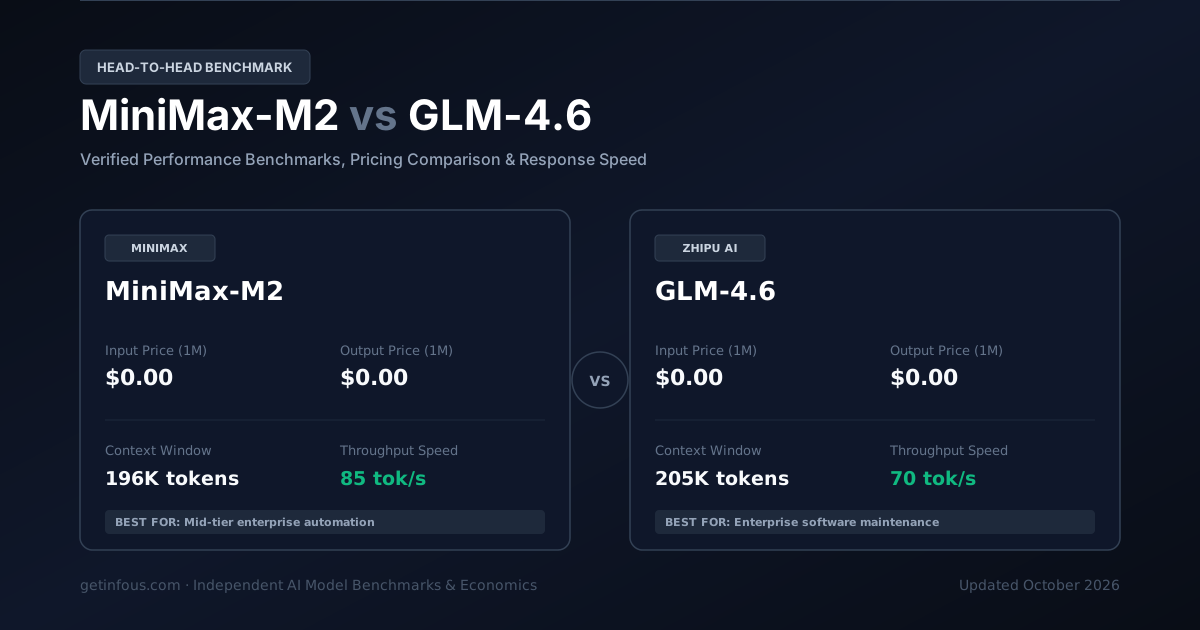
MiniMax-M2 de MiniMax y GLM-4.6 de Zhipu AI compiten directamente en el ecosistema actual de IA. MiniMax-M2 ofrece una ventana de contexto de 196K tokens a $0.00/$0.00 por millón de tokens (entrada/salida), mientras que GLM-4.6 ofrece 204.8K tokens de contexto a $0.00/$0.00 por millón de tokens. Analizamos sus benchmarks, latencia y costos reales.
Cambia y Compara Cualquier Modelo
Select any AI models from our verified benchmark database to generate live side-by-side matrices.
MiniMax-M2
IA Agéntica y Uso de HerramientasMiniMax-M2 de MiniMax es un modelo de IA diseñado para flujos de trabajo agénticos autónomos, llamada a herramientas y automatización compleja, con ventana de contexto de 196K, velocidad de 85 tokens/s, índice de inteligencia de 78/100 y ta
$0.00 / 1M
$0.00 / 1M
196K tokens
N/A
GLM-4.6
Modelo Base de Pesos AbiertosGLM-4.6 de Zhipu AI es un modelo de IA diseñado para autoalojamiento en servidores propios, ajuste fino (fine-tuning) y soberanía de datos, con ventana de contexto de 205K, velocidad de 70 tokens/s, índice de inteligencia de 82/100 y tarifa
$0.00 / 1M
$0.00 / 1M
204.8K tokens
48%
Diferencias Clave de un Vistazo
- Both models cost the same under this workload — choose on capability, not price.
- GLM-4.6 has a larger context window (205K vs 196K tokens).
- MiniMax-M2 is faster at 85 tok/s vs 70 tok/s.
| Característica | MiniMax-M2 | GLM-4.6 |
|---|---|---|
Intelligence Index Composite reasoning & knowledge score (0-100) | 78 | 82 |
Provider | MiniMax | Zhipu AI |
Input Price Cost per million input tokens | $0.00 / 1M | $0.00 / 1M |
Output Price Cost per million output tokens | $0.00 / 1M | $0.00 / 1M |
Blended Price Weighted 7:2:1 cache:input:output per 1M | $0.00 / 1M | $0.00 / 1M |
Context Window Maximum input + output tokens | 196K tokens~294 A4 pages of text | 204.8K tokens~307 A4 pages of text |
Max Output Tokens Per single request | 8K | 8K |
Throughput Speed Tokens generated per second | 85 tok/s | 70 tok/s |
SWE-bench Verified Real-world software engineering | N/A | 48% |
GPQA Diamond Graduate-level reasoning | 58% | 63.5% |
¿Quién gana en cada área?
At-a-glance decision frameworkEvaluations ongoing
Puntuaciones de Benchmarks Verificadas
Official evaluation metrics verified by independent third-party research labs.
Industry benchmark evaluating real-world GitHub issue resolution and multi-file debugging.
Challenging questions created by domain experts to test complex PhD-level reasoning.
Hardened reasoning and academic knowledge benchmark with reduced lucky-guess probability.
Crowdsourced human preference evaluation based on blind, head-to-head model battles.
Tokens emitted per second during active generation streaming.
Latencia y Tiempo de Respuesta
Time to first token (TTFT) and estimated end-to-end response time for a typical 500-token response.
Simulador Interactivo de Costos de Tokens
Adjust sliders to calculate projected monthly cloud API spending with prompt caching discounts.
MiniMax-M2 · Strengths & Key Advantages
- Ventana de contexto de 196K con hasta 8K tokens de salida máxima (GPQA Diamond 58% · MMLU-Pro 74%)
- Rendimiento ágil de 85 tokens/segundo con latencia inicial (TTFT) de solo 440 ms
- Pesos abiertos (Confidential / 120B MoE) listos para autoalojamiento local o en nube privada mediante vLLM y Ollama
Considerations & Trade-offs
- Requiere infraestructura GPU dedicada con suficiente memoria VRAM para inferencia local sin cuantización
- En demostraciones científicas extremas, los modelos de razonamiento pesado de gama alta ofrecen mayor profundidad
GLM-4.6 · Strengths & Key Advantages
- Ventana de contexto de 205K con hasta 8K tokens de salida máxima (SWE-bench Verified 48% · GPQA Diamond 63.5%)
- Rendimiento ágil de 70 tokens/segundo con latencia inicial (TTFT) de solo 560 ms
- Pesos abiertos (150B MoE) listos para autoalojamiento local o en nube privada mediante vLLM y Ollama
Considerations & Trade-offs
- Requiere infraestructura GPU dedicada con suficiente memoria VRAM para inferencia local sin cuantización
- En demostraciones científicas extremas, los modelos de razonamiento pesado de gama alta ofrecen mayor profundidad
Token Use & Task Economics
Estimated cost and token consumption to complete one representative agentic task.
| Metric | MiniMax-M2 | GLM-4.6 |
|---|---|---|
Cost per Task Estimated USD to finish one task | $0.00 | $0.00 |
Output Tokens / Task Tokens generated per task | 15K | 18K |
Reasoning Tokens / Task Thinking tokens burned per task | 3K | 6K |
Especificaciones Técnicas
Architecture, release timeline, capabilities, and modalities.
| Característica | MiniMax-M2 | GLM-4.6 |
|---|---|---|
| Official API Model ID (SDK) | minimax-m2 | glm-4-6 |
| API Protocol | OpenAI-Compatible REST / vLLM / SGLang / HuggingFace TGI | OpenAI-Compatible REST / vLLM / SGLang / HuggingFace TGI |
| Release Date | 2025-10 | 2025-09 |
| Knowledge Cutoff | August 2025 | July 2025 |
| Architecture | High-Efficiency Open Mixture-of-Experts Transformer | Advanced Mixture-of-Experts Enterprise Transformer |
| Parameters | Confidential / 120B MoE | 150B MoE |
| Enterprise Rate Limits (RPM / TPM) | Unlimited (Hardware-bound on self-hosted GPU) / 10,000 RPM Cloud · Unlimited local throughput / 10M+ TPM Managed Cloud | Unlimited (Hardware-bound on self-hosted GPU) / 10,000 RPM Cloud · Unlimited local throughput / 10M+ TPM Managed Cloud |
| Long-Context Tier (>128K/200K) | Free across full context window (only KV-cache VRAM scales) | Free across full context window (only KV-cache VRAM scales) |
| Prompt Cache Policy & TTL | Automatic prefix KV-caching in vLLM / SGLang (0 cost) | Automatic prefix KV-caching in vLLM / SGLang (0 cost) |
| Computer Use / GUI Agent | API / CLI Tool-Use & DOM Agent ready (no raw pixel desktop click loop) | API / CLI Tool-Use & DOM Agent ready (no raw pixel desktop click loop) |
| MCP & Parallel Tool Calling | Native MCP Client/Server ready · Parallel function calling · 100% Strict JSON Schema | Native MCP Client/Server ready · Parallel function calling · 100% Strict JSON Schema |
| Web Search Grounding & Sandbox | Supported via external Tavily/Exa Search & E2B/Docker Sandbox tools | Supported via external Tavily/Exa Search & E2B/Docker Sandbox tools |
| Official Fine-Tuning Support | Full Weights SFT, LoRA, QLoRA, DPO & GRPO RL (Unsloth / Axolotl / Llama-Factory) | Full Weights SFT, LoRA, QLoRA, DPO & GRPO RL (Unsloth / Axolotl / Llama-Factory) |
| Multimodal Token Billing | Text BPE (~4 chars/token) | Text BPE (~4 chars/token) |
| Quantization & Min GPU VRAM | BF16 / FP16, FP8 Dynamic, INT4 AWQ / GPTQ, GGUF (Q4_K_M / Q8_0) · 74 GB VRAM (4-bit Quantized) · 258 GB VRAM (Native BF16) | BF16 / FP16, FP8 Dynamic, INT4 AWQ / GPTQ, GGUF (Q4_K_M / Q8_0) · 93 GB VRAM (4-bit Quantized) · 323 GB VRAM (Native BF16) |
| Safety & Frontier Classification | Open-Weights System Card + Customizable Guardrail Layer (Llama Guard / ShieldGemma) | Open-Weights System Card + Customizable Guardrail Layer (Llama Guard / ShieldGemma) |
| Enterprise Compliance (ZDR/HIPAA/SOC2) | 100% Air-Gapped On-Premises / Private VPC · Full HIPAA, GDPR & SOC2 Control | 100% Air-Gapped On-Premises / Private VPC · Full HIPAA, GDPR & SOC2 Control |
| Input Modalities | text | text |
| Output Modalities | text | text |
MiniMax-M2 vs GLM-4.6: Respuestas Rápidas (FAQ)
Which is more intelligent, MiniMax-M2 or GLM-4.6?
GLM-4.6 is more intelligent. It scores 82 compared with 78 on the composite Intelligence Index.
Which model is faster?
MiniMax-M2 is faster, generating 85 tokens per second compared with 70 tokens per second.
Which model has lower latency?
MiniMax-M2 has lower latency, with a time to first token of 0.44s compared with 0.56s.
Which model has a larger context window?
GLM-4.6 has a larger context window, supporting 204.8K tokens compared with 196K tokens.
Veredicto
Tanto MiniMax-M2 (Ideal para flujos de trabajo agénticos autónomos, llamada a herramientas y automatización compleja, sistemas RAG empresariales y automatización mediante API.) como GLM-4.6 (Ideal para autoalojamiento en servidores propios, ajuste fino (fine-tuning) y soberanía de datos, sistemas RAG empresariales y automatización mediante API.) destacan en producción: GLM-4.6 lidera en inteligencia general y programación, MiniMax-M2 ofrece mayor velocidad de generación de tokens y MiniMax-M2 resulta más rentable para cargas de trabajo API de alto volumen.
Preguntas frecuentes
¿Cuál es mejor para programación y razonamiento, MiniMax-M2 o GLM-4.6?+
En las pruebas de inteligencia compuesta y resolución de código, GLM-4.6 obtiene la ventaja. Puedes revisar la tabla SWE-bench y GPQA arriba para comparar cada métrica.
¿Cuánto cuesta la API de MiniMax-M2 frente a GLM-4.6?+
MiniMax-M2 cuesta $0.00 / $0.00 por millón de tokens de entrada/salida, mientras que GLM-4.6 cuesta $0.00 / $0.00. En costo combinado, MiniMax-M2 es la opción más económica.
¿Qué modelo tiene mayor ventana de contexto y menor latencia?+
MiniMax-M2 cuenta con 196K tokens de contexto frente a 204.8K tokens de GLM-4.6. En velocidad de inferencia, MiniMax-M2 ofrece un rendimiento superior.
Understand key metrics like context window, token pricing, reasoning mode, and SWE-bench scores in our comprehensive AI glossary.
Related reading
- GLM-4.6 vs. Qwen3-Next 80B-A3B (Thinking): Comparativa de Benchmarks, Precios API y Velocidad (2026)Comparar
- GLM-4.6V vs. GLM-4.6: Comparativa de Benchmarks, Precios API y Velocidad (2026)Comparar
- MiniMax-M2.1 vs. MiniMax-M2: Comparativa de Benchmarks, Precios API y Velocidad (2026)Comparar
- Aion-3.0 vs. Aion-Mini: Comparativa de Benchmarks, Precios API y Velocidad (2026)Comparar
- Aion-3.0 vs. Gemini 3.6 Flash: Comparativa de Benchmarks, Precios API y Velocidad (2026)Comparar
- Aion-Mini vs. Laguna XS 2.1: Comparativa de Benchmarks, Precios API y Velocidad (2026)Comparar
Las puntuaciones de benchmarks, precios por token y límites de tasa evolucionan rápidamente. Verifique siempre las especificaciones actuales en la documentación oficial del proveedor.
Fuentes: Documentación oficial de API de MiniMax y Zhipu AI, tarjetas de sistema y benchmarks independientes (2026).