Kimi K2.5 vs MiniMax-M2.7
Benchmarks, API Token Pricing, Context Window & Speed Comparison
Related topics (12)
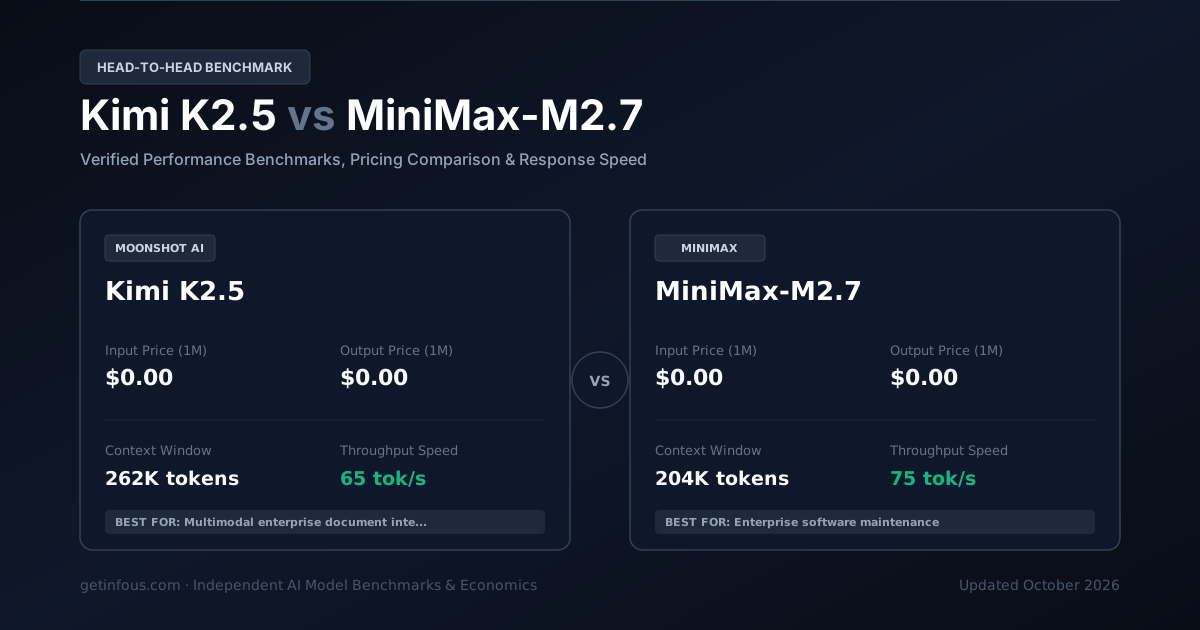
Kimi K2.5 by Moonshot AI and MiniMax-M2.7 by MiniMax represent two of the frontier AI models analyzed in our comprehensive 2026 AI benchmark and LLM comparison. In this head-to-head evaluation, we examine API token pricing, context window specifications, inference speed (tokens per second), and empirical reasoning performance. From a pure economic perspective, both models offer identical input token rates. On output generation, costs are matched. In data-heavy architectures requiring extensive repository or document analysis, Kimi K2.5 provides an expanded memory horizon with 262K tokens. In latency-sensitive production environments, MiniMax-M2.7 leads in tokens-per-second throughput, making it ideal for real-time conversational agents and high-concurrency workflows. Below is the complete empirical head-to-head breakdown across cost, speed, context, and capability matrices.
Cambia y Compara Cualquier Modelo
Select any AI models from our verified benchmark database to generate live side-by-side matrices.
Kimi K2.5
Kimi multimodalMoonshot de AI early-2026 de frontera abierto multimodal modelo integrating alto-resolución visión, de contexto largo recuperación, y flujos de trabajo agénticos.
$0.00 / 1M
$0.00 / 1M
262.1K tokens
52%
MiniMax-M2.7
Agente insigniade MiniMax spring 2026 abierto insignia excelling en complejo office automatización, multi-herramienta agente environments, y ingeniería de software.
$0.00 / 1M
$0.00 / 1M
204K tokens
56%
Diferencias Clave de un Vistazo
- Both models cost the same under this workload — choose on capability, not price.
- Kimi K2.5 has a larger context window (262K vs 204K tokens).
- MiniMax-M2.7 is faster at 75 tok/s vs 65 tok/s.
- MiniMax-M2.7 leads on SWE-bench coding (56.0% vs 52.0%).
| Característica | Kimi K2.5 | MiniMax-M2.7 |
|---|---|---|
Intelligence Index Composite reasoning & knowledge score (0-100) | 86 | 85 |
Provider | Moonshot AI | MiniMax |
Input Price Cost per million input tokens | $0.00 / 1M | $0.00 / 1M |
Output Price Cost per million output tokens | $0.00 / 1M | $0.00 / 1M |
Blended Price Weighted 7:2:1 cache:input:output per 1M | $0.00 / 1M | $0.00 / 1M |
Context Window Maximum input + output tokens | 262.1K tokens~393 A4 pages of text | 204K tokens~306 A4 pages of text |
Max Output Tokens Per single request | 16K | 16K |
Throughput Speed Tokens generated per second | 65 tok/s | 75 tok/s |
SWE-bench Verified Real-world software engineering | 52% | 56% |
GPQA Diamond Graduate-level reasoning | 69.5% | 67.5% |
¿Quién gana en cada área?
At-a-glance decision frameworkPuntuaciones de Benchmarks Verificadas
Official evaluation metrics verified by independent third-party research labs.
Industry benchmark evaluating real-world GitHub issue resolution and multi-file debugging.
Challenging questions created by domain experts to test complex PhD-level reasoning.
Hardened reasoning and academic knowledge benchmark with reduced lucky-guess probability.
Crowdsourced human preference evaluation based on blind, head-to-head model battles.
Tokens emitted per second during active generation streaming.
Latencia y Tiempo de Respuesta
Time to first token (TTFT) and estimated end-to-end response time for a typical 500-token response.
Simulador Interactivo de Costos de Tokens
Adjust sliders to calculate projected monthly cloud API spending with prompt caching discounts.
Kimi K2.5 · Strengths & Key Advantages
- Seamless visual fundamentación y multi-imagen documento comprensión
- sólido 262K ventana de contexto preservation con alto needle recuperación precisión
- de pesos abiertos con permissive comercial license
Considerations & Trade-offs
- sustancial GPU resource requirements para unquantized inferencia
- Slightly mayor generación verbosity en conversacional prompts
MiniMax-M2.7 · Strengths & Key Advantages
- 56% SWE-bench Verified codificación score establishing de frontera abierto credentials
- Refined multipaso herramienta ejecución con minimal failure cascades
- de pesos abiertos lanzamiento con complete implementación freedom
Considerations & Trade-offs
- texto-solo modelo; carece de visual imagen y video procesamiento
- M3 supersedes ello con broader multimodal contexto
Token Use & Task Economics
Estimated cost and token consumption to complete one representative agentic task.
| Metric | Kimi K2.5 | MiniMax-M2.7 |
|---|---|---|
Cost per Task Estimated USD to finish one task | $0.00 | $0.00 |
Output Tokens / Task Tokens generated per task | 24K | 22K |
Reasoning Tokens / Task Thinking tokens burned per task | 8K | 7K |
Especificaciones Técnicas
Architecture, release timeline, capabilities, and modalities.
| Característica | Kimi K2.5 | MiniMax-M2.7 |
|---|---|---|
| Official API Model ID (SDK) | kimi-k2-5 | minimax-m2-7 |
| API Protocol | OpenAI-Compatible REST / vLLM / SGLang / HuggingFace TGI | OpenAI-Compatible REST / vLLM / SGLang / HuggingFace TGI |
| Release Date | 2026-01 | 2026-03 |
| Knowledge Cutoff | November 2025 | January 2026 |
| Architecture | Multimodal Open Mixture-of-Experts Transformer | Enterprise Open MoE Foundation Transformer |
| Parameters | 1.2T total (36B active MoE) | Confidential / 220B MoE |
| Enterprise Rate Limits (RPM / TPM) | Unlimited (Hardware-bound on self-hosted GPU) / 10,000 RPM Cloud · Unlimited local throughput / 10M+ TPM Managed Cloud | Unlimited (Hardware-bound on self-hosted GPU) / 10,000 RPM Cloud · Unlimited local throughput / 10M+ TPM Managed Cloud |
| Long-Context Tier (>128K/200K) | Free across full context window (only KV-cache VRAM scales) | Free across full context window (only KV-cache VRAM scales) |
| Prompt Cache Policy & TTL | Automatic prefix KV-caching in vLLM / SGLang (0 cost) | Automatic prefix KV-caching in vLLM / SGLang (0 cost) |
| Computer Use / GUI Agent | Supported (Screen coordinate grounding, browser & desktop GUI action loops) | API / CLI Tool-Use & DOM Agent ready (no raw pixel desktop click loop) |
| MCP & Parallel Tool Calling | Native MCP Client/Server ready · Parallel function calling · 100% Strict JSON Schema | Native MCP Client/Server ready · Parallel function calling · 100% Strict JSON Schema |
| Web Search Grounding & Sandbox | Supported via external Tavily/Exa Search & E2B/Docker Sandbox tools | Supported via external Tavily/Exa Search & E2B/Docker Sandbox tools |
| Official Fine-Tuning Support | Full Weights SFT, LoRA, QLoRA, DPO & GRPO RL (Unsloth / Axolotl / Llama-Factory) | Full Weights SFT, LoRA, QLoRA, DPO & GRPO RL (Unsloth / Axolotl / Llama-Factory) |
| Multimodal Token Billing | Text BPE (~4 chars/token) · Vision (~258–765 tokens per image tile) | Text BPE (~4 chars/token) |
| Quantization & Min GPU VRAM | BF16 / FP16, FP8 Dynamic, INT4 AWQ / GPTQ, GGUF (Q4_K_M / Q8_0) · 744 GB VRAM (4-bit Quantized) · 2580 GB VRAM (Native BF16) | BF16 / FP16, FP8 Dynamic, INT4 AWQ / GPTQ, GGUF (Q4_K_M / Q8_0) · 136 GB VRAM (4-bit Quantized) · 473 GB VRAM (Native BF16) |
| Safety & Frontier Classification | Open-Weights System Card + Customizable Guardrail Layer (Llama Guard / ShieldGemma) | Open-Weights System Card + Customizable Guardrail Layer (Llama Guard / ShieldGemma) |
| Enterprise Compliance (ZDR/HIPAA/SOC2) | 100% Air-Gapped On-Premises / Private VPC · Full HIPAA, GDPR & SOC2 Control | 100% Air-Gapped On-Premises / Private VPC · Full HIPAA, GDPR & SOC2 Control |
| Input Modalities | text, vision | text |
| Output Modalities | text | text |
Kimi K2.5 vs MiniMax-M2.7: Respuestas Rápidas (FAQ)
Which is more intelligent, Kimi K2.5 or MiniMax-M2.7?
Kimi K2.5 is more intelligent. It scores 86 compared with 85 on the composite Intelligence Index.
Which model is faster?
MiniMax-M2.7 is faster, generating 75 tokens per second compared with 65 tokens per second.
Which model has lower latency?
MiniMax-M2.7 has lower latency, with a time to first token of 0.51s compared with 0.62s.
Which model has a larger context window?
Kimi K2.5 has a larger context window, supporting 262.1K tokens compared with 204K tokens.
Veredicto
Verdict & Model Selection Recommendation: Choose Kimi K2.5 if your priority is Multimodal enterprise document intelligence, visual bug fixing, and self-hosted agents. Its performance in demanding tasks justifies its operational token cost. Choose MiniMax-M2.7 if your workflow prioritizes Enterprise software maintenance, automated document workflows, and sovereign agents. For large-scale batch processing or customer-facing conversational interfaces, its balance of speed and economics delivers superior ROI.
Preguntas frecuentes
How does Kimi K2.5 compare to MiniMax-M2.7 in API token pricing and cost per token?+
Both Kimi K2.5 and MiniMax-M2.7 are open-weights foundation models available at $0.00 direct API cost when self-hosted, or offered at identical baseline rates across major inference providers. Model selection depends on GPU deployment sizing and specialized benchmark performance rather than raw token price.
Which model has a larger context window: Kimi K2.5 or MiniMax-M2.7?+
Kimi K2.5 supports a context window of 262K tokens (~197k words), while MiniMax-M2.7 supports 204K tokens (~153k words). Therefore, Kimi K2.5 can process more textual data and document context in a single prompt.
Which AI model is better for software engineering and coding: Kimi K2.5 or MiniMax-M2.7?+
Kimi K2.5 scores 52% on SWE-bench Verified while MiniMax-M2.7 scores 56%. For autonomous software engineering and multi-file debugging, MiniMax-M2.7 holds the verified benchmark lead.
What is the difference in reasoning capability and extended thinking between Kimi K2.5 and MiniMax-M2.7?+
Kimi K2.5 features native chain-of-thought extended thinking mode with configurable reasoning effort. In contrast, MiniMax-M2.7 provides chain-of-thought reasoning depth for complex math and science.
How does inference speed (tokens per second) compare between Kimi K2.5 and MiniMax-M2.7?+
Kimi K2.5 generates approximately 65 tokens per second, while MiniMax-M2.7 delivers 75 tokens per second. In latency-sensitive production environments, MiniMax-M2.7 provides faster time-to-first-token (TTFT) and higher streaming response velocity.
Can you implement a tiered LLM routing setup combining Kimi K2.5 and MiniMax-M2.7 to optimize costs?+
Yes! Tiered multi-model routing can optimize for latency and accuracy: you can route high-frequency conversational turns and latency-sensitive queries to MiniMax-M2.7, and route deep architectural or complex reasoning queries to Kimi K2.5. This balanced routing strategy maximizes system throughput and answer quality.
Understand key metrics like context window, token pricing, reasoning mode, and SWE-bench scores in our comprehensive AI glossary.
Related reading
- Kimi K2.5 vs Kimi K2 Thinking: Benchmarks, Pricing & Speed ComparisonComparar
- Kimi K2.6 vs Kimi K2.5: Benchmarks, Pricing & Speed ComparisonComparar
- MiniMax-M2.7 vs MiniMax-M2.5: Benchmarks, Pricing & Speed ComparisonComparar
- MiniMax-M3 vs MiniMax-M2.7: Benchmarks, Pricing & Speed ComparisonComparar
- Aion-3.0 vs Aion-Mini: Benchmarks, Pricing & Speed ComparisonComparar
- Aion-3.0 vs Gemini 3.6 Flash: Benchmarks, Pricing & Speed ComparisonComparar
Las puntuaciones de benchmarks, precios por token y límites de tasa evolucionan rápidamente. Verifique siempre las especificaciones actuales en la documentación oficial del proveedor.
Fuentes: GetInfoUs Independent AI Benchmarks & Official API Specs