Gemini 2.0 Flash vs Gemini 1.5 Flash
Benchmarks, API Token Pricing, Context Window & Speed Comparison
Related topics (12)
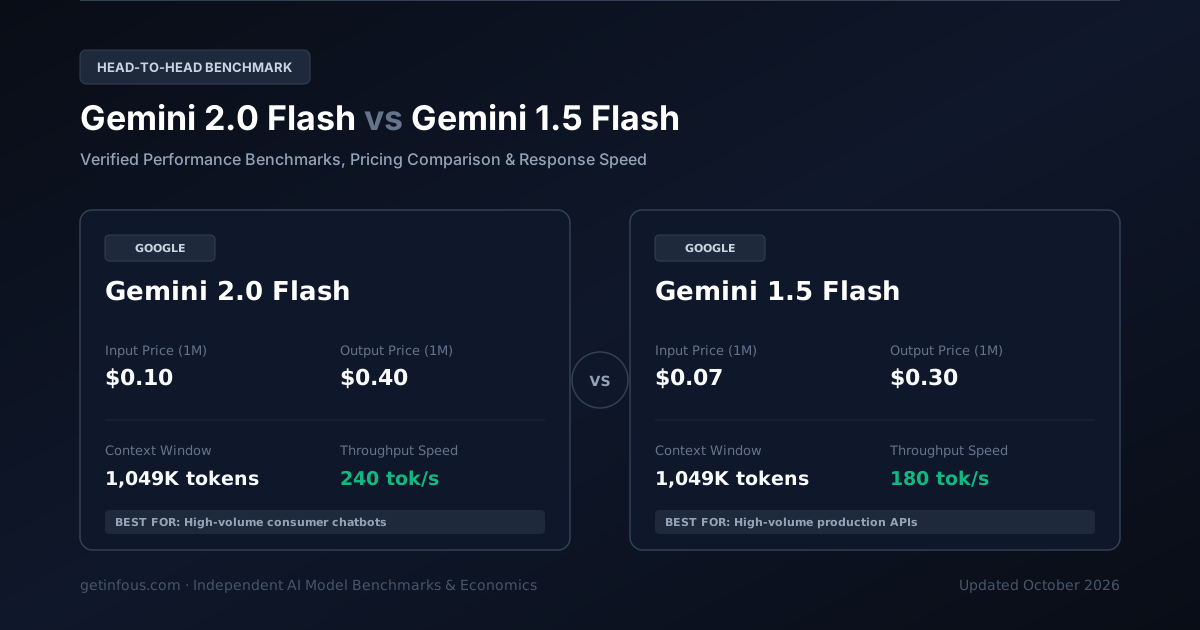
Gemini 2.0 Flash de Google y Gemini 1.5 Flash de Google compiten directamente en el ecosistema actual de IA. Gemini 2.0 Flash ofrece una ventana de contexto de 1.05M tokens a $0.10/$0.40 por millón de tokens (entrada/salida), mientras que Gemini 1.5 Flash ofrece 1.05M tokens de contexto a $0.07/$0.30 por millón de tokens. Analizamos sus benchmarks, latencia y costos reales.
Cambia y Compara Cualquier Modelo
Select any AI models from our verified benchmark database to generate live side-by-side matrices.
Gemini 2.0 Flash
Inferencia UltrarrápidaGemini 2.0 Flash de Google es un modelo de IA diseñado para interacción en tiempo real, baja latencia y enrutamiento de alto volumen, con ventana de contexto de 1.0M, velocidad de 240 tokens/s, índice de inteligencia de 40/100 y tarifa de $
$0.10 / 1M
$0.40 / 1M
1.05M tokens
42%
Gemini 1.5 Flash
Inferencia UltrarrápidaGemini 1.5 Flash de Google es un modelo de IA diseñado para interacción en tiempo real, baja latencia y enrutamiento de alto volumen, con ventana de contexto de 1.0M, velocidad de 180 tokens/s, índice de inteligencia de 38/100 y tarifa de $
$0.07 / 1M
$0.30 / 1M
1.05M tokens
20%
Diferencias Clave de un Vistazo
- Gemini 1.5 Flash is 1.3x cheaper for API usage (input + output tokens combined).
- Gemini 2.0 Flash is faster at 240 tok/s vs 180 tok/s.
- Gemini 2.0 Flash leads on SWE-bench coding (42.0% vs 20.0%).
| Característica | Gemini 2.0 Flash | Gemini 1.5 Flash |
|---|---|---|
Intelligence Index Composite reasoning & knowledge score (0-100) | 40 | 38 |
Provider | ||
Input Price Cost per million input tokens | $0.10 / 1M | $0.07 / 1M |
Output Price Cost per million output tokens | $0.40 / 1M | $0.30 / 1M |
Blended Price Weighted 7:2:1 cache:input:output per 1M | $0.08 / 1M | $0.06 / 1M |
Context Window Maximum input + output tokens | 1.05M tokens~1,573 A4 pages of text | 1.05M tokens~1,573 A4 pages of text |
Max Output Tokens Per single request | 8K | 8K |
Throughput Speed Tokens generated per second | 240 tok/s | 180 tok/s |
SWE-bench Verified Real-world software engineering | 42% | 20% |
GPQA Diamond Graduate-level reasoning | 55.4% | 42.1% |
Cached Input Price Prompt caching discount per 1M tokens | $0.03 / 1M | $0.02 / 1M |
¿Quién gana en cada área?
At-a-glance decision frameworkPuntuaciones de Benchmarks Verificadas
Official evaluation metrics verified by independent third-party research labs.
Industry benchmark evaluating real-world GitHub issue resolution and multi-file debugging.
Challenging questions created by domain experts to test complex PhD-level reasoning.
Hardened reasoning and academic knowledge benchmark with reduced lucky-guess probability.
Crowdsourced human preference evaluation based on blind, head-to-head model battles.
Extremely difficult, closed-ended questions spanning the frontier of human expert knowledge.
Autonomous multi-step tasks executed inside a real command-line terminal environment.
Research-grade coding problems drawn from real scientific and numerical workloads.
Contamination-free competitive programming problems collected continuously over time.
American Invitational Mathematics Examination — multi-step Olympiad-level reasoning.
Accuracy when reasoning over very large inputs that fill the model context window.
Tokens emitted per second during active generation streaming.
Latencia y Tiempo de Respuesta
Time to first token (TTFT) and estimated end-to-end response time for a typical 500-token response.
Simulador Interactivo de Costos de Tokens
Adjust sliders to calculate projected monthly cloud API spending with prompt caching discounts.
Gemini 2.0 Flash · Strengths & Key Advantages
- Ventana de contexto de 1.0M con hasta 8K tokens de salida máxima (SWE-bench Verified 42% · GPQA Diamond 55.4%)
- Rendimiento ágil de 240 tokens/segundo con latencia inicial (TTFT) de solo 280 ms
- Economía de API competitiva ($0.1/$0.4 por 1M de tokens) con soporte para caché de prompts y salidas JSON estructuradas
Considerations & Trade-offs
- Modelo propietario en la nube; no permite descargar los pesos para ejecución local sin conexión
- En demostraciones científicas extremas, los modelos de razonamiento pesado de gama alta ofrecen mayor profundidad
Gemini 1.5 Flash · Strengths & Key Advantages
- Ventana de contexto de 1.0M con hasta 8K tokens de salida máxima (SWE-bench Verified 20% · GPQA Diamond 42.1%)
- Rendimiento ágil de 180 tokens/segundo con latencia inicial (TTFT) de solo 320 ms
- Economía de API competitiva ($0.075/$0.3 por 1M de tokens) con soporte para caché de prompts y salidas JSON estructuradas
Considerations & Trade-offs
- Modelo propietario en la nube; no permite descargar los pesos para ejecución local sin conexión
- En demostraciones científicas extremas, los modelos de razonamiento pesado de gama alta ofrecen mayor profundidad
Token Use & Task Economics
Estimated cost and token consumption to complete one representative agentic task.
| Metric | Gemini 2.0 Flash | Gemini 1.5 Flash |
|---|---|---|
Cost per Task Estimated USD to finish one task | $0.13 | $0.20 |
Output Tokens / Task Tokens generated per task | 60K | 24K |
Reasoning Tokens / Task Thinking tokens burned per task | 33K | 0K |
Especificaciones Técnicas
Architecture, release timeline, capabilities, and modalities.
| Característica | Gemini 2.0 Flash | Gemini 1.5 Flash |
|---|---|---|
| Official API Model ID (SDK) | models/gemini-2-flash | models/gemini-1-5-flash |
| API Protocol | Google Gemini API (generateContent) + OpenAI-Compatible SDK | Google Gemini API (generateContent) + OpenAI-Compatible SDK |
| Release Date | 2024-12 | 2024-05 |
| Knowledge Cutoff | August 2024 | May 2024 |
| Architecture | Multimodal Flash MoE | Distilled Sparse MoE Multimodal |
| Parameters | Confidential | Confidential |
| Enterprise Rate Limits (RPM / TPM) | 10,000 – 30,000 RPM (Tier 5 Enterprise) · 4,000,000 – 10,000,000 TPM | 10,000 – 30,000 RPM (Tier 5 Enterprise) · 4,000,000 – 10,000,000 TPM |
| Long-Context Tier (>128K/200K) | Standard rate up to 200K tokens; 2x input/output tier above 200K tokens | Standard rate up to 200K tokens; 2x input/output tier above 200K tokens |
| Prompt Cache Policy & TTL | Implicit + Explicit Context Caching at $0.025/1M with configurable TTL | Implicit + Explicit Context Caching at $0.01875/1M with configurable TTL |
| Computer Use / GUI Agent | Supported (Screen coordinate grounding, browser & desktop GUI action loops) | Supported (Screen coordinate grounding, browser & desktop GUI action loops) |
| MCP & Parallel Tool Calling | Native MCP Client/Server ready · Parallel function calling · 100% Strict JSON Schema | Native MCP Client/Server ready · Parallel function calling · 100% Strict JSON Schema |
| Web Search Grounding & Sandbox | Built-in Google Search Grounding + Managed Python Code Execution Sandbox | Built-in Google Search Grounding + Managed Python Code Execution Sandbox |
| Official Fine-Tuning Support | Vertex AI Supervised Adapter Tuning & Context Distillation | Vertex AI Supervised Adapter Tuning & Context Distillation |
| Multimodal Token Billing | Text BPE (~4 chars/token) · Vision (~258–765 tokens per image tile) · Audio (~25–32 tokens/sec) · Video (~258–300 tokens/sec) | Text BPE (~4 chars/token) · Vision (~258–765 tokens per image tile) · Audio (~25–32 tokens/sec) · Video (~258–300 tokens/sec) |
| Quantization & Min GPU VRAM | Cloud-Hosted Proprietary (FP8 / BF16 Tensor Core Cluster) · Zero Local VRAM Required (100% Serverless Cloud API) | Cloud-Hosted Proprietary (FP8 / BF16 Tensor Core Cluster) · Zero Local VRAM Required (100% Serverless Cloud API) |
| Safety & Frontier Classification | Google DeepMind Frontier Safety Framework Verified | Google DeepMind Frontier Safety Framework Verified |
| Enterprise Compliance (ZDR/HIPAA/SOC2) | SOC2 Type II · GDPR · Zero Data Retention (ZDR) & HIPAA BAA Available on Enterprise Tier | SOC2 Type II · GDPR · Zero Data Retention (ZDR) & HIPAA BAA Available on Enterprise Tier |
| Input Modalities | text, vision, audio, video | text, vision, audio, video |
| Output Modalities | text | text |
Gemini 2.0 Flash vs Gemini 1.5 Flash: Respuestas Rápidas (FAQ)
Which is more intelligent, Gemini 2.0 Flash or Gemini 1.5 Flash?
Gemini 2.0 Flash is more intelligent. It scores 40 compared with 38 on the composite Intelligence Index.
Which model is faster?
Gemini 2.0 Flash is faster, generating 240 tokens per second compared with 180 tokens per second.
Which model is cheaper to run?
Gemini 1.5 Flash is cheaper at $0.06 per 1M tokens blended, compared with $0.08 (7:2:1 cache:input:output ratio).
Which model has lower latency?
Gemini 2.0 Flash has lower latency, with a time to first token of 0.28s compared with 0.32s.
Veredicto
Tanto Gemini 2.0 Flash (Ideal para interacción en tiempo real, baja latencia y enrutamiento de alto volumen, sistemas RAG empresariales y automatización mediante API.) como Gemini 1.5 Flash (Ideal para interacción en tiempo real, baja latencia y enrutamiento de alto volumen, sistemas RAG empresariales y automatización mediante API.) destacan en producción: Gemini 2.0 Flash lidera en inteligencia general y programación, Gemini 2.0 Flash ofrece mayor velocidad de generación de tokens y Gemini 1.5 Flash resulta más rentable para cargas de trabajo API de alto volumen.
Preguntas frecuentes
¿Cuál es mejor para programación y razonamiento, Gemini 2.0 Flash o Gemini 1.5 Flash?+
En las pruebas de inteligencia compuesta y resolución de código, Gemini 2.0 Flash obtiene la ventaja. Puedes revisar la tabla SWE-bench y GPQA arriba para comparar cada métrica.
¿Cuánto cuesta la API de Gemini 2.0 Flash frente a Gemini 1.5 Flash?+
Gemini 2.0 Flash cuesta $0.10 / $0.40 por millón de tokens de entrada/salida, mientras que Gemini 1.5 Flash cuesta $0.07 / $0.30. En costo combinado, Gemini 1.5 Flash es la opción más económica.
¿Qué modelo tiene mayor ventana de contexto y menor latencia?+
Gemini 2.0 Flash cuenta con 1.05M tokens de contexto frente a 1.05M tokens de Gemini 1.5 Flash. En velocidad de inferencia, Gemini 2.0 Flash ofrece un rendimiento superior.
Understand key metrics like context window, token pricing, reasoning mode, and SWE-bench scores in our comprehensive AI glossary.
Related reading
- Claude 3.5 Haiku vs. Gemini 2.0 Flash: Comparativa de Benchmarks, Precios API y Velocidad (2026)Comparar
- Claude 3 Haiku vs. Gemini 1.5 Flash: Comparativa de Benchmarks, Precios API y Velocidad (2026)Comparar
- Gemini 2.0 Flash vs. GPT-4o mini: Comparativa de Benchmarks, Precios API y Velocidad (2026)Comparar
- Gemini 2.0 Pro vs. Gemini 2.0 Flash: Comparativa de Benchmarks, Precios API y Velocidad (2026)Comparar
- Aion-3.0 vs. Aion-Mini: Comparativa de Benchmarks, Precios API y Velocidad (2026)Comparar
- Aion-3.0 vs. Gemini 3.6 Flash: Comparativa de Benchmarks, Precios API y Velocidad (2026)Comparar
Las puntuaciones de benchmarks, precios por token y límites de tasa evolucionan rápidamente. Verifique siempre las especificaciones actuales en la documentación oficial del proveedor.
Fuentes: Documentación oficial de API de Google y Google, tarjetas de sistema y benchmarks independientes (2026).