Claude Opus 4 vs Claude Sonnet 4
Benchmarks, API Token Pricing, Context Window & Speed Comparison
Related topics (12)
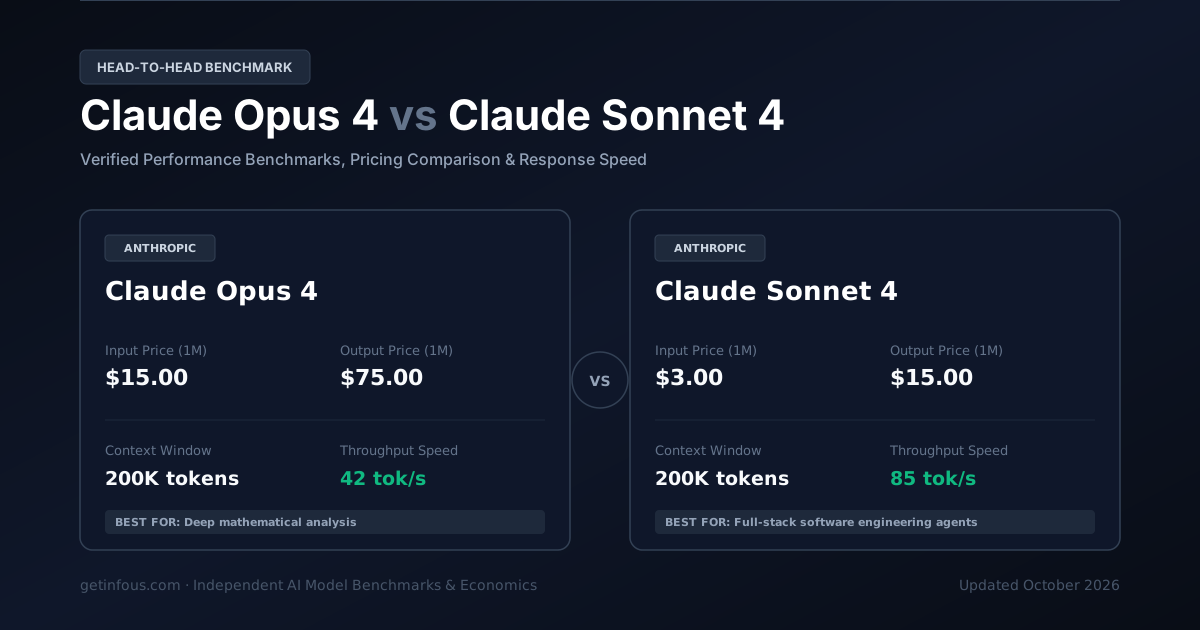
Claude Opus 4 da Anthropic e Claude Sonnet 4 da Anthropic são dois modelos de IA de destaque. O Claude Opus 4 oferece uma janela de contexto de 200K tokens a $15.00/$75.00 por milhão de tokens, enquanto o Claude Sonnet 4 oferece 200K tokens de contexto a $3.00/$15.00 por milhão de tokens. Veja abaixo a comparação completa de benchmarks, latência e custos.
Troque e Compare Qualquer Modelo
Select any AI models from our verified benchmark database to generate live side-by-side matrices.
Claude Opus 4
Motor de Raciocínio ProfundoO Claude Opus 4 da Anthropic é um modelo de IA projetado para raciocínio lógico profundo, matemática avançada e análise científica passo a passo, oferecendo janela de contexto de 200K, velocidade de 42 tokens/s, índice de inteligência de 61
$15.00 / 1M
$75.00 / 1M
200K tokens
72.5%
Claude Sonnet 4
IA Agêntica e Uso de FerramentasO Claude Sonnet 4 da Anthropic é um modelo de IA projetado para fluxos de trabalho agênticos autônomos, chamada de ferramentas e automação, oferecendo janela de contexto de 200K, velocidade de 85 tokens/s, índice de inteligência de 58/100 e
$3.00 / 1M
$15.00 / 1M
200K tokens
72.7%
Principais Diferenças em Resumo
- Claude Sonnet 4 is 5.0x cheaper for API usage (input + output tokens combined).
- Claude Sonnet 4 is faster at 85 tok/s vs 42 tok/s.
- Claude Sonnet 4 leads on SWE-bench coding (72.7% vs 72.5%).
| Feature | Claude Opus 4 | Claude Sonnet 4 |
|---|---|---|
Intelligence Index Composite reasoning & knowledge score (0-100) | 61 | 58 |
Provider | Anthropic | Anthropic |
Input Price Cost per million input tokens | $15.00 / 1M | $3.00 / 1M |
Output Price Cost per million output tokens | $75.00 / 1M | $15.00 / 1M |
Blended Price Weighted 7:2:1 cache:input:output per 1M | $11.55 / 1M | $2.31 / 1M |
Context Window Maximum input + output tokens | 200K tokens~300 A4 pages of text | 200K tokens~300 A4 pages of text |
Max Output Tokens Per single request | 32K | 64K |
Throughput Speed Tokens generated per second | 42 tok/s | 85 tok/s |
SWE-bench Verified Real-world software engineering | 72.5% | 72.7% |
GPQA Diamond Graduate-level reasoning | 73.8% | 71.2% |
Cached Input Price Prompt caching discount per 1M tokens | $1.50 / 1M | $0.30 / 1M |
Quem vence em cada categoria?
At-a-glance decision frameworkPontuações de Benchmarks Verificadas
Official evaluation metrics verified by independent third-party research labs.
Industry benchmark evaluating real-world GitHub issue resolution and multi-file debugging.
Challenging questions created by domain experts to test complex PhD-level reasoning.
Hardened reasoning and academic knowledge benchmark with reduced lucky-guess probability.
Crowdsourced human preference evaluation based on blind, head-to-head model battles.
Autonomous multi-step tasks executed inside a real command-line terminal environment.
Tokens emitted per second during active generation streaming.
Latência e Tempo de Resposta
Time to first token (TTFT) and estimated end-to-end response time for a typical 500-token response.
Simulador Interativo de Custo de Tokens
Adjust sliders to calculate projected monthly cloud API spending with prompt caching discounts.
Claude Opus 4 · Strengths & Key Advantages
- Janela de contexto de 200K com limite máximo de saída de 32K tokens (SWE-bench Verified 72.5% · GPQA Diamond 73.8%)
- Taxa de transferência rápida de 42 tokens/segundo com latência inicial (TTFT) de 1800 ms
- Economia de API competitiva ($15/$75 por 1M de tokens) com suporte a cache de prompts e saídas JSON estruturadas
Considerations & Trade-offs
- Modelo proprietário em nuvem; não permite download dos pesos para execução local offline
- Para alto volume de requisições, recomenda-se ativar o cache de prompts e a Batch API para reduzir custos
Claude Sonnet 4 · Strengths & Key Advantages
- Janela de contexto de 200K com limite máximo de saída de 64K tokens (SWE-bench Verified 72.7% · GPQA Diamond 71.2%)
- Taxa de transferência rápida de 85 tokens/segundo com latência inicial (TTFT) de 520 ms
- Economia de API competitiva ($3/$15 por 1M de tokens) com suporte a cache de prompts e saídas JSON estruturadas
Considerations & Trade-offs
- Modelo proprietário em nuvem; não permite download dos pesos para execução local offline
- Para alto volume de requisições, recomenda-se ativar o cache de prompts e a Batch API para reduzir custos
Token Use & Task Economics
Estimated cost and token consumption to complete one representative agentic task.
| Metric | Claude Opus 4 | Claude Sonnet 4 |
|---|---|---|
Cost per Task Estimated USD to finish one task | $16.46 | $3.29 |
Output Tokens / Task Tokens generated per task | 72K | 72K |
Reasoning Tokens / Task Thinking tokens burned per task | 37K | 37K |
Especificações Técnicas
Architecture, release timeline, capabilities, and modalities.
| Feature | Claude Opus 4 | Claude Sonnet 4 |
|---|---|---|
| Official API Model ID (SDK) | claude-opus-4-20250501 | claude-sonnet-4-20250501 |
| API Protocol | Anthropic Messages API + AWS Bedrock + Vertex AI | Anthropic Messages API + AWS Bedrock + Vertex AI |
| Release Date | 2025-05 | 2025-05 |
| Knowledge Cutoff | March 2025 | March 2025 |
| Architecture | Dense Frontier Reasoning Transformer | Hybrid Multimodal Reasoning Transformer |
| Parameters | Confidential | Confidential |
| Enterprise Rate Limits (RPM / TPM) | 4,000 – 10,000 RPM (Tier 4 + Priority Tier) · 800,000 – 2,000,000 TPM | 4,000 – 10,000 RPM (Tier 4 + Priority Tier) · 800,000 – 2,000,000 TPM |
| Long-Context Tier (>128K/200K) | Standard rate up to 200K tokens; 2x input/output tier above 200K tokens | Standard rate up to 200K tokens; 2x input/output tier above 200K tokens |
| Prompt Cache Policy & TTL | $1.5/1M cached read (90% off); 5-min default & 1-hour extended TTL | $0.3/1M cached read (90% off); 5-min default & 1-hour extended TTL |
| Computer Use / GUI Agent | Supported (Screen coordinate grounding, browser & desktop GUI action loops) | Supported (Screen coordinate grounding, browser & desktop GUI action loops) |
| MCP & Parallel Tool Calling | Native MCP Client/Server ready · Parallel function calling · 100% Strict JSON Schema | Native MCP Client/Server ready · Parallel function calling · 100% Strict JSON Schema |
| Web Search Grounding & Sandbox | Native Web Search Citations + Code Execution Tool + MCP Connectors | Native Web Search Citations + Code Execution Tool + MCP Connectors |
| Official Fine-Tuning Support | Custom Model Tuning via Amazon Bedrock & Prompt Distillation | Custom Model Tuning via Amazon Bedrock & Prompt Distillation |
| Multimodal Token Billing | Text BPE (~4 chars/token) · Vision (~258–765 tokens per image tile) | Text BPE (~4 chars/token) · Vision (~258–765 tokens per image tile) |
| Quantization & Min GPU VRAM | Cloud-Hosted Proprietary (FP8 / BF16 Tensor Core Cluster) · Zero Local VRAM Required (100% Serverless Cloud API) | Cloud-Hosted Proprietary (FP8 / BF16 Tensor Core Cluster) · Zero Local VRAM Required (100% Serverless Cloud API) |
| Safety & Frontier Classification | Anthropic RSP ASL-2 / ASL-3 Constitutional Safety Evaluated | Anthropic RSP ASL-2 / ASL-3 Constitutional Safety Evaluated |
| Enterprise Compliance (ZDR/HIPAA/SOC2) | SOC2 Type II · GDPR · Zero Data Retention (ZDR) & HIPAA BAA Available on Enterprise Tier | SOC2 Type II · GDPR · Zero Data Retention (ZDR) & HIPAA BAA Available on Enterprise Tier |
| Input Modalities | text, vision | text, vision |
| Output Modalities | text | text |
Claude Opus 4 vs Claude Sonnet 4: Respostas Rápidas (FAQ)
Which is more intelligent, Claude Opus 4 or Claude Sonnet 4?
Claude Opus 4 is more intelligent. It scores 61 compared with 58 on the composite Intelligence Index.
Which model is faster?
Claude Sonnet 4 is faster, generating 85 tokens per second compared with 42 tokens per second.
Which model is cheaper to run?
Claude Sonnet 4 is cheaper at $2.31 per 1M tokens blended, compared with $11.55 (7:2:1 cache:input:output ratio).
Which model has lower latency?
Claude Sonnet 4 has lower latency, with a time to first token of 0.52s compared with 1.80s.
Veredito
Tanto Claude Opus 4 (Indicado para raciocínio lógico profundo, matemática avançada e análise científica passo a passo, arquiteturas RAG corporativas e integração escalável via API.) quanto Claude Sonnet 4 (Indicado para fluxos de trabalho agênticos autônomos, chamada de ferramentas e automação, arquiteturas RAG corporativas e integração escalável via API.) entregam excelente desempenho: Claude Opus 4 lidera em inteligência geral e programação, Claude Sonnet 4 oferece geração mais rápida e Claude Sonnet 4 apresenta o melhor custo-benefício em produção.
Perguntas Frequentes (FAQ)
Qual é melhor para programação e raciocínio, Claude Opus 4 ou Claude Sonnet 4?+
Nas avaliações de inteligência e código, Claude Opus 4 leva vantagem. Confira os gráficos SWE-bench e GPQA acima para detalhes.
Qual modelo tem a API mais barata, Claude Opus 4 ou Claude Sonnet 4?+
O Claude Opus 4 custa $15.00 / $75.00 por 1M de tokens (entrada/saída) e o Claude Sonnet 4 custa $3.00 / $15.00. No custo combinado, Claude Sonnet 4 é mais econômico.
Qual modelo possui maior janela de contexto e velocidade?+
O Claude Opus 4 suporta 200K tokens de contexto contra 200K tokens do Claude Sonnet 4, enquanto Claude Sonnet 4 entrega maior velocidade de geração.
Understand key metrics like context window, token pricing, reasoning mode, and SWE-bench scores in our comprehensive AI glossary.
Related reading
- Claude Opus 4.1 vs. Claude Opus 4: Comparação de Benchmarks, Preços API e Velocidade (2026)Comparar
- Claude Opus 4 vs. Gemini 2.5 Flash-Lite: Comparação de Benchmarks, Preços API e Velocidade (2026)Comparar
- Claude Sonnet 4 vs. Claude 3.7 Sonnet: Comparação de Benchmarks, Preços API e Velocidade (2026)Comparar
- Claude Sonnet 4 vs. o1-pro: Comparação de Benchmarks, Preços API e Velocidade (2026)Comparar
- Aion-3.0 vs. Aion-Mini: Comparação de Benchmarks, Preços API e Velocidade (2026)Comparar
- Aion-3.0 vs. Gemini 3.6 Flash: Comparação de Benchmarks, Preços API e Velocidade (2026)Comparar
Benchmark scores, token prices, and rate limits evolve rapidly as AI labs release model updates. Always verify current specifications and pricing on the official provider documentation.
Fontes oficiais: Documentação oficial de API da Anthropic e Anthropic e benchmarks independentes (2026).