Claude Opus 4.1 vs Claude Opus 4
Benchmarks, API Token Pricing, Context Window & Speed Comparison
Related topics (12)
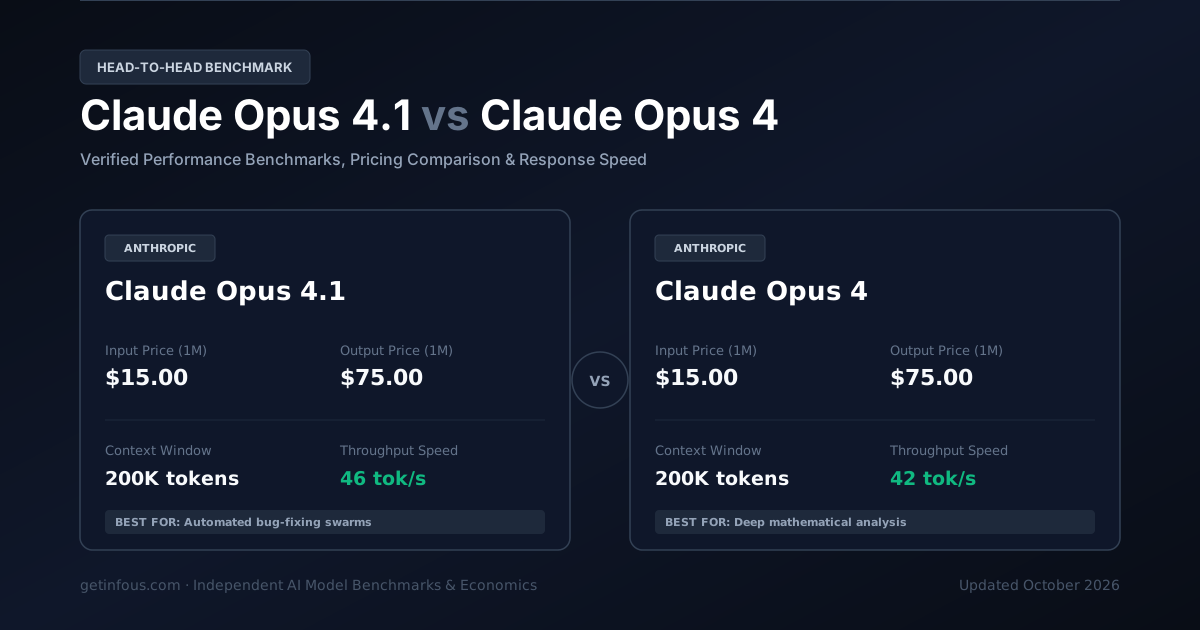
Claude Opus 4.1 da Anthropic e Claude Opus 4 da Anthropic são dois modelos de IA de destaque. O Claude Opus 4.1 oferece uma janela de contexto de 200K tokens a $15.00/$75.00 por milhão de tokens, enquanto o Claude Opus 4 oferece 200K tokens de contexto a $15.00/$75.00 por milhão de tokens. Veja abaixo a comparação completa de benchmarks, latência e custos.
Troque e Compare Qualquer Modelo
Select any AI models from our verified benchmark database to generate live side-by-side matrices.
Claude Opus 4.1
IA Agêntica e Uso de FerramentasO Claude Opus 4.1 da Anthropic é um modelo de IA projetado para fluxos de trabalho agênticos autônomos, chamada de ferramentas e automação, oferecendo janela de contexto de 200K, velocidade de 46 tokens/s, índice de inteligência de 62/100 e
$15.00 / 1M
$75.00 / 1M
200K tokens
74.5%
Claude Opus 4
Motor de Raciocínio ProfundoO Claude Opus 4 da Anthropic é um modelo de IA projetado para raciocínio lógico profundo, matemática avançada e análise científica passo a passo, oferecendo janela de contexto de 200K, velocidade de 42 tokens/s, índice de inteligência de 61
$15.00 / 1M
$75.00 / 1M
200K tokens
72.5%
Principais Diferenças em Resumo
- Both models cost the same under this workload — choose on capability, not price.
- Claude Opus 4.1 is faster at 46 tok/s vs 42 tok/s.
- Claude Opus 4.1 leads on SWE-bench coding (74.5% vs 72.5%).
| Feature | Claude Opus 4.1 | Claude Opus 4 |
|---|---|---|
Intelligence Index Composite reasoning & knowledge score (0-100) | 62 | 61 |
Provider | Anthropic | Anthropic |
Input Price Cost per million input tokens | $15.00 / 1M | $15.00 / 1M |
Output Price Cost per million output tokens | $75.00 / 1M | $75.00 / 1M |
Blended Price Weighted 7:2:1 cache:input:output per 1M | $11.55 / 1M | $11.55 / 1M |
Context Window Maximum input + output tokens | 200K tokens~300 A4 pages of text | 200K tokens~300 A4 pages of text |
Max Output Tokens Per single request | 32K | 32K |
Throughput Speed Tokens generated per second | 46 tok/s | 42 tok/s |
SWE-bench Verified Real-world software engineering | 74.5% | 72.5% |
GPQA Diamond Graduate-level reasoning | 74.4% | 73.8% |
Cached Input Price Prompt caching discount per 1M tokens | $1.50 / 1M | $1.50 / 1M |
Quem vence em cada categoria?
At-a-glance decision frameworkPontuações de Benchmarks Verificadas
Official evaluation metrics verified by independent third-party research labs.
Industry benchmark evaluating real-world GitHub issue resolution and multi-file debugging.
Challenging questions created by domain experts to test complex PhD-level reasoning.
Hardened reasoning and academic knowledge benchmark with reduced lucky-guess probability.
Crowdsourced human preference evaluation based on blind, head-to-head model battles.
Autonomous multi-step tasks executed inside a real command-line terminal environment.
Tokens emitted per second during active generation streaming.
Latência e Tempo de Resposta
Time to first token (TTFT) and estimated end-to-end response time for a typical 500-token response.
Simulador Interativo de Custo de Tokens
Adjust sliders to calculate projected monthly cloud API spending with prompt caching discounts.
Claude Opus 4.1 · Strengths & Key Advantages
- Janela de contexto de 200K com limite máximo de saída de 32K tokens (SWE-bench Verified 74.5% · GPQA Diamond 74.4%)
- Taxa de transferência rápida de 46 tokens/segundo com latência inicial (TTFT) de 1700 ms
- Economia de API competitiva ($15/$75 por 1M de tokens) com suporte a cache de prompts e saídas JSON estruturadas
Considerations & Trade-offs
- Modelo proprietário em nuvem; não permite download dos pesos para execução local offline
- Para alto volume de requisições, recomenda-se ativar o cache de prompts e a Batch API para reduzir custos
Claude Opus 4 · Strengths & Key Advantages
- Janela de contexto de 200K com limite máximo de saída de 32K tokens (SWE-bench Verified 72.5% · GPQA Diamond 73.8%)
- Taxa de transferência rápida de 42 tokens/segundo com latência inicial (TTFT) de 1800 ms
- Economia de API competitiva ($15/$75 por 1M de tokens) com suporte a cache de prompts e saídas JSON estruturadas
Considerations & Trade-offs
- Modelo proprietário em nuvem; não permite download dos pesos para execução local offline
- Para alto volume de requisições, recomenda-se ativar o cache de prompts e a Batch API para reduzir custos
Token Use & Task Economics
Estimated cost and token consumption to complete one representative agentic task.
| Metric | Claude Opus 4.1 | Claude Opus 4 |
|---|---|---|
Cost per Task Estimated USD to finish one task | $16.46 | $16.46 |
Output Tokens / Task Tokens generated per task | 72K | 72K |
Reasoning Tokens / Task Thinking tokens burned per task | 37K | 37K |
Especificações Técnicas
Architecture, release timeline, capabilities, and modalities.
| Feature | Claude Opus 4.1 | Claude Opus 4 |
|---|---|---|
| Official API Model ID (SDK) | claude-opus-4-1-20250801 | claude-opus-4-20250501 |
| API Protocol | Anthropic Messages API + AWS Bedrock + Vertex AI | Anthropic Messages API + AWS Bedrock + Vertex AI |
| Release Date | 2025-08 | 2025-05 |
| Knowledge Cutoff | March 2025 | March 2025 |
| Architecture | Refined Frontier Reasoning Transformer | Dense Frontier Reasoning Transformer |
| Parameters | Confidential | Confidential |
| Enterprise Rate Limits (RPM / TPM) | 4,000 – 10,000 RPM (Tier 4 + Priority Tier) · 800,000 – 2,000,000 TPM | 4,000 – 10,000 RPM (Tier 4 + Priority Tier) · 800,000 – 2,000,000 TPM |
| Long-Context Tier (>128K/200K) | Standard rate up to 200K tokens; 2x input/output tier above 200K tokens | Standard rate up to 200K tokens; 2x input/output tier above 200K tokens |
| Prompt Cache Policy & TTL | $1.5/1M cached read (90% off); 5-min default & 1-hour extended TTL | $1.5/1M cached read (90% off); 5-min default & 1-hour extended TTL |
| Computer Use / GUI Agent | Supported (Screen coordinate grounding, browser & desktop GUI action loops) | Supported (Screen coordinate grounding, browser & desktop GUI action loops) |
| MCP & Parallel Tool Calling | Native MCP Client/Server ready · Parallel function calling · 100% Strict JSON Schema | Native MCP Client/Server ready · Parallel function calling · 100% Strict JSON Schema |
| Web Search Grounding & Sandbox | Native Web Search Citations + Code Execution Tool + MCP Connectors | Native Web Search Citations + Code Execution Tool + MCP Connectors |
| Official Fine-Tuning Support | Custom Model Tuning via Amazon Bedrock & Prompt Distillation | Custom Model Tuning via Amazon Bedrock & Prompt Distillation |
| Multimodal Token Billing | Text BPE (~4 chars/token) · Vision (~258–765 tokens per image tile) | Text BPE (~4 chars/token) · Vision (~258–765 tokens per image tile) |
| Quantization & Min GPU VRAM | Cloud-Hosted Proprietary (FP8 / BF16 Tensor Core Cluster) · Zero Local VRAM Required (100% Serverless Cloud API) | Cloud-Hosted Proprietary (FP8 / BF16 Tensor Core Cluster) · Zero Local VRAM Required (100% Serverless Cloud API) |
| Safety & Frontier Classification | Anthropic RSP ASL-2 / ASL-3 Constitutional Safety Evaluated | Anthropic RSP ASL-2 / ASL-3 Constitutional Safety Evaluated |
| Enterprise Compliance (ZDR/HIPAA/SOC2) | SOC2 Type II · GDPR · Zero Data Retention (ZDR) & HIPAA BAA Available on Enterprise Tier | SOC2 Type II · GDPR · Zero Data Retention (ZDR) & HIPAA BAA Available on Enterprise Tier |
| Input Modalities | text, vision | text, vision |
| Output Modalities | text | text |
Claude Opus 4.1 vs Claude Opus 4: Respostas Rápidas (FAQ)
Which is more intelligent, Claude Opus 4.1 or Claude Opus 4?
Claude Opus 4.1 is more intelligent. It scores 62 compared with 61 on the composite Intelligence Index.
Which model is faster?
Claude Opus 4.1 is faster, generating 46 tokens per second compared with 42 tokens per second.
Which model has lower latency?
Claude Opus 4.1 has lower latency, with a time to first token of 1.70s compared with 1.80s.
Veredito
Tanto Claude Opus 4.1 (Indicado para fluxos de trabalho agênticos autônomos, chamada de ferramentas e automação, arquiteturas RAG corporativas e integração escalável via API.) quanto Claude Opus 4 (Indicado para raciocínio lógico profundo, matemática avançada e análise científica passo a passo, arquiteturas RAG corporativas e integração escalável via API.) entregam excelente desempenho: Claude Opus 4.1 lidera em inteligência geral e programação, Claude Opus 4.1 oferece geração mais rápida e Claude Opus 4.1 apresenta o melhor custo-benefício em produção.
Perguntas Frequentes (FAQ)
Qual é melhor para programação e raciocínio, Claude Opus 4.1 ou Claude Opus 4?+
Nas avaliações de inteligência e código, Claude Opus 4.1 leva vantagem. Confira os gráficos SWE-bench e GPQA acima para detalhes.
Qual modelo tem a API mais barata, Claude Opus 4.1 ou Claude Opus 4?+
O Claude Opus 4.1 custa $15.00 / $75.00 por 1M de tokens (entrada/saída) e o Claude Opus 4 custa $15.00 / $75.00. No custo combinado, Claude Opus 4.1 é mais econômico.
Qual modelo possui maior janela de contexto e velocidade?+
O Claude Opus 4.1 suporta 200K tokens de contexto contra 200K tokens do Claude Opus 4, enquanto Claude Opus 4.1 entrega maior velocidade de geração.
Understand key metrics like context window, token pricing, reasoning mode, and SWE-bench scores in our comprehensive AI glossary.
Related reading
- Claude Opus 4.1 vs. Gemini 2.5 Computer Use: Comparação de Benchmarks, Preços API e Velocidade (2026)Comparar
- Claude Opus 4 vs. Claude Sonnet 4: Comparação de Benchmarks, Preços API e Velocidade (2026)Comparar
- Claude Opus 4 vs. Gemini 2.5 Flash-Lite: Comparação de Benchmarks, Preços API e Velocidade (2026)Comparar
- Aion-3.0 vs. Aion-Mini: Comparação de Benchmarks, Preços API e Velocidade (2026)Comparar
- Aion-3.0 vs. Gemini 3.6 Flash: Comparação de Benchmarks, Preços API e Velocidade (2026)Comparar
- Aion-Mini vs. Laguna XS 2.1: Comparação de Benchmarks, Preços API e Velocidade (2026)Comparar
Benchmark scores, token prices, and rate limits evolve rapidly as AI labs release model updates. Always verify current specifications and pricing on the official provider documentation.
Fontes oficiais: Documentação oficial de API da Anthropic e Anthropic e benchmarks independentes (2026).