DeepSeek V4 Pro vs Claude Opus 5.5
Benchmarks, API Token Pricing, Context Window & Speed Comparison
Related topics (12)
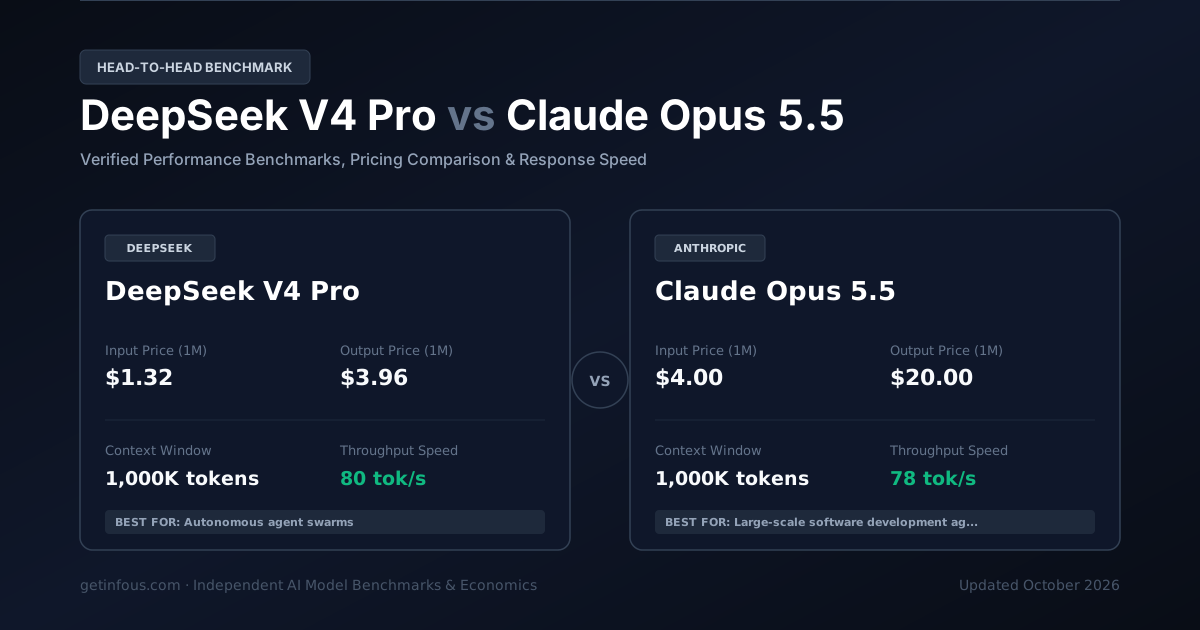
DeepSeek V4 Pro di DeepSeek e Claude Opus 5.5 di Anthropic sono due modelli di IA di riferimento. DeepSeek V4 Pro offre una finestra di contesto di 1M token a $1.32/$3.96 per milione di token, mentre Claude Opus 5.5 mette a disposizione 1M token di contesto a $4.00/$20.00 per milione di token. Di seguito analizziamo benchmark, latenza e costi.
Cambia e Confronta Qualsiasi Modello
Select any AI models from our verified benchmark database to generate live side-by-side matrices.
DeepSeek V4 Pro
IA Agentica e Strumenti AutonomiDeepSeek V4 Pro di DeepSeek è un modello di IA progettato per i workflow agentici autonomi, il tool calling e l’automazione multi-step, con finestra di contesto da 1M, velocità di 80 token/s, indice di intelligenza di 53/100 e tariffa di $1
$1.32 / 1M
$3.96 / 1M
1M tokens
68.5%
Claude Opus 5.5
Modello Ammiraglia di FrontieraClaude Opus 5.5 di Anthropic è un modello di IA progettato per il ragionamento aziendale di frontiera, la programmazione avanzata e i carichi di produzione, con finestra di contesto da 1M, velocità di 78 token/s, indice di intelligenza di 9
$4.00 / 1M
$20.00 / 1M
1M tokens
84.6%
Differenze Chiave a Colpo d’Occhio
- DeepSeek V4 Pro is 4.3x cheaper for API usage (input + output tokens combined).
- DeepSeek V4 Pro is faster at 80 tok/s vs 78 tok/s.
- Claude Opus 5.5 leads on SWE-bench coding (84.6% vs 68.5%).
| Feature | DeepSeek V4 Pro | Claude Opus 5.5 |
|---|---|---|
Intelligence Index Composite reasoning & knowledge score (0-100) | 53 | 94 |
Provider | DeepSeek | Anthropic |
Input Price Cost per million input tokens | $1.32 / 1M | $4.00 / 1M |
Output Price Cost per million output tokens | $3.96 / 1M | $20.00 / 1M |
Blended Price Weighted 7:2:1 cache:input:output per 1M | $0.76 / 1M | $3.08 / 1M |
Context Window Maximum input + output tokens | 1M tokens~1,500 A4 pages of text | 1M tokens~1,500 A4 pages of text |
Max Output Tokens Per single request | 128K | 128K |
Throughput Speed Tokens generated per second | 80 tok/s | 78 tok/s |
SWE-bench Verified Real-world software engineering | 68.5% | 84.6% |
GPQA Diamond Graduate-level reasoning | 81.2% | 82.3% |
Cached Input Price Prompt caching discount per 1M tokens | $0.14 / 1M | $0.40 / 1M |
Chi vince in ogni categoria?
At-a-glance decision frameworkPunteggi Benchmark Verificati
Official evaluation metrics verified by independent third-party research labs.
Industry benchmark evaluating real-world GitHub issue resolution and multi-file debugging.
Challenging questions created by domain experts to test complex PhD-level reasoning.
Hardened reasoning and academic knowledge benchmark with reduced lucky-guess probability.
Crowdsourced human preference evaluation based on blind, head-to-head model battles.
Extremely difficult, closed-ended questions spanning the frontier of human expert knowledge.
Autonomous multi-step tasks executed inside a real command-line terminal environment.
Research-grade coding problems drawn from real scientific and numerical workloads.
Contamination-free competitive programming problems collected continuously over time.
American Invitational Mathematics Examination — multi-step Olympiad-level reasoning.
Accuracy when reasoning over very large inputs that fill the model context window.
Tokens emitted per second during active generation streaming.
Latenza e Tempo di Risposta
Time to first token (TTFT) and estimated end-to-end response time for a typical 500-token response.
Simulatore Interattivo dei Costi Token
Adjust sliders to calculate projected monthly cloud API spending with prompt caching discounts.
DeepSeek V4 Pro · Strengths & Key Advantages
- Finestra di contesto da 1M con capacità massima di output fino a 128K token (SWE-bench Verified 68.5% · GPQA Diamond 81.2%)
- Throughput elevato di 80 token/secondo con latenza al primo token (TTFT) di soli 580 ms
- Pesi aperti (MoE (Colossal)) pronti per il self-hosting locale o su cloud privato tramite vLLM, SGLang o Ollama
Considerations & Trade-offs
- Richiede server GPU dedicati con sufficiente memoria VRAM per l’esecuzione locale a piena precisione
- Nelle dimostrazioni scientifiche più estreme, i modelli di ragionamento pesante dedicati offrono maggiore profondità
Claude Opus 5.5 · Strengths & Key Advantages
- Finestra di contesto da 1M con capacità massima di output fino a 128K token (SWE-bench Verified 84.6% · GPQA Diamond 82.3%)
- Throughput elevato di 78 token/secondo con latenza al primo token (TTFT) di soli 1400 ms
- Economia API competitiva ($4/$20 per 1M di token) con supporto per prompt caching, tool calling e output JSON strutturati
Considerations & Trade-offs
- Modello cloud proprietario chiuso; non consente il download locale dei pesi per l’esecuzione offline
- Per volumi di traffico elevati in produzione si consiglia di attivare il prompt caching e la Batch API
Token Use & Task Economics
Estimated cost and token consumption to complete one representative agentic task.
| Metric | DeepSeek V4 Pro | Claude Opus 5.5 |
|---|---|---|
Cost per Task Estimated USD to finish one task | $0.67 | $3.85 |
Output Tokens / Task Tokens generated per task | 52K | 68K |
Reasoning Tokens / Task Thinking tokens burned per task | 25K | 42K |
Specifiche Tecniche
Architecture, release timeline, capabilities, and modalities.
| Feature | DeepSeek V4 Pro | Claude Opus 5.5 |
|---|---|---|
| Official API Model ID (SDK) | deepseek-reasoner | claude-opus-5-5-20260901 |
| API Protocol | OpenAI-Compatible REST / vLLM / SGLang / HuggingFace TGI | Anthropic Messages API + AWS Bedrock + Vertex AI |
| Release Date | 2026-08 | 2026-09 |
| Knowledge Cutoff | May 2026 | June 2026 |
| Architecture | Next-Gen Sparse MoE with Agent RL Tuning | Extended Autonomous Hybrid Reasoning Transformer |
| Parameters | MoE (Colossal) | Confidential |
| Enterprise Rate Limits (RPM / TPM) | Unlimited (Hardware-bound on self-hosted GPU) / 10,000 RPM Cloud · Unlimited local throughput / 10M+ TPM Managed Cloud | 4,000 – 10,000 RPM (Tier 4 + Priority Tier) · 4,000,000 – 10,000,000 TPM |
| Long-Context Tier (>128K/200K) | Flat rate ($1.32/1M in) across full 1000K window | Standard rate up to 200K tokens; 2x input/output tier above 200K tokens |
| Prompt Cache Policy & TTL | Automatic prefix caching at $0.14/1M (no extra cache-write fee) | $0.4/1M cached read (90% off); 5-min default & 1-hour extended TTL |
| Computer Use / GUI Agent | API / CLI Tool-Use & DOM Agent ready (no raw pixel desktop click loop) | Supported (Screen coordinate grounding, browser & desktop GUI action loops) |
| MCP & Parallel Tool Calling | Native MCP Client/Server ready · Parallel function calling · 100% Strict JSON Schema | Native MCP Client/Server ready · Parallel function calling · 100% Strict JSON Schema |
| Web Search Grounding & Sandbox | Supported via external Tavily/Exa Search & E2B/Docker Sandbox tools | Native Web Search Citations + Code Execution Tool + MCP Connectors |
| Official Fine-Tuning Support | Full Weights SFT, LoRA, QLoRA, DPO & GRPO RL (Unsloth / Axolotl / Llama-Factory) | Custom Model Tuning via Amazon Bedrock & Prompt Distillation |
| Multimodal Token Billing | Text BPE (~4 chars/token) | Text BPE (~4 chars/token) · Vision (~258–765 tokens per image tile) |
| Quantization & Min GPU VRAM | BF16 / FP16, FP8 Dynamic, INT4 AWQ / GPTQ, GGUF (Q4_K_M / Q8_0) · 43 GB VRAM (4-bit Quantized) · 151 GB VRAM (Native BF16) | Cloud-Hosted Proprietary (FP8 / BF16 Tensor Core Cluster) · Zero Local VRAM Required (100% Serverless Cloud API) |
| Safety & Frontier Classification | Open-Weights System Card + Customizable Guardrail Layer (Llama Guard / ShieldGemma) | Anthropic RSP ASL-2 / ASL-3 Constitutional Safety Evaluated |
| Enterprise Compliance (ZDR/HIPAA/SOC2) | 100% Air-Gapped On-Premises / Private VPC · Full HIPAA, GDPR & SOC2 Control | SOC2 Type II · GDPR · Zero Data Retention (ZDR) & HIPAA BAA Available on Enterprise Tier |
| Input Modalities | text | text, vision |
| Output Modalities | text | text |
DeepSeek V4 Pro vs Claude Opus 5.5: Risposte Rapide (FAQ)
Which is more intelligent, DeepSeek V4 Pro or Claude Opus 5.5?
Claude Opus 5.5 is more intelligent. It scores 94 compared with 53 on the composite Intelligence Index.
Which model is faster?
DeepSeek V4 Pro is faster, generating 80 tokens per second compared with 78 tokens per second.
Which model is cheaper to run?
DeepSeek V4 Pro is cheaper at $0.76 per 1M tokens blended, compared with $3.08 (7:2:1 cache:input:output ratio).
Which model has lower latency?
DeepSeek V4 Pro has lower latency, with a time to first token of 0.58s compared with 1.40s.
Verdetto
Sia DeepSeek V4 Pro (Ideale per i workflow agentici autonomi, il tool calling e l’automazione multi-step, sistemi RAG aziendali e integrazioni API scalabili.) sia Claude Opus 5.5 (Ideale per il ragionamento aziendale di frontiera, la programmazione avanzata e i carichi di produzione, sistemi RAG aziendali e integrazioni API scalabili.) eccellono in produzione: Claude Opus 5.5 guida nei benchmark di ragionamento e programmazione, DeepSeek V4 Pro garantisce una generazione più rapida e DeepSeek V4 Pro offre il miglior rapporto qualità-prezzo per carichi API elevati.
Domande Frequenti (FAQ)
Quale modello è migliore per coding e ragionamento, DeepSeek V4 Pro o Claude Opus 5.5?+
Nell’indice di intelligenza composito e nei benchmark di programmazione prevale Claude Opus 5.5. Consulta i punteggi SWE-bench e GPQA qui sopra per tutti i dettagli.
Qual è la differenza di prezzo API tra DeepSeek V4 Pro e Claude Opus 5.5?+
DeepSeek V4 Pro costa $1.32 / $3.96 per milione di token di input/output, mentre Claude Opus 5.5 costa $4.00 / $20.00. Nel costo combinato, DeepSeek V4 Pro risulta più economico.
Quale modello ha la finestra di contesto più ampia e la velocità maggiore?+
DeepSeek V4 Pro supporta 1M token di contesto contro 1M token di Claude Opus 5.5, mentre DeepSeek V4 Pro offre una velocità di generazione superiore.
Understand key metrics like context window, token pricing, reasoning mode, and SWE-bench scores in our comprehensive AI glossary.
Related reading
- Claude Mythos 5.1 vs Claude Opus 5.5: Confronto Benchmark, Prezzi API e Velocità (2026)Confronta
- Claude Opus 5.5 vs Gemini 4 Argon: Confronto Benchmark, Prezzi API e Velocità (2026)Confronta
- Claude Opus 5 vs Claude Opus 5.5: Confronto Benchmark, Prezzi API e Velocità (2026)Confronta
- Claude Sonnet 5.5 vs DeepSeek V4 Pro: Confronto Benchmark, Prezzi API e Velocità (2026)Confronta
- Command A Plus vs Claude Opus 5.5: Confronto Benchmark, Prezzi API e Velocità (2026)Confronta
- DeepSeek V4 Pro vs GPT-6 Astra: Confronto Benchmark, Prezzi API e Velocità (2026)Confronta
Benchmark scores, token prices, and rate limits evolve rapidly as AI labs release model updates. Always verify current specifications and pricing on the official provider documentation.
Fonti ufficiali: Documentazione API ufficiale di DeepSeek e Anthropic, schede di sistema e benchmark indipendenti (2026).