Enterprise AI Governance in Late 2026: Navigating EU AI Act GPAI Rules, SOC2, and Zero-Data-Retention APIs
As General-Purpose AI (GPAI) transparency rules and enterprise data residency mandates take full effect in 2026, chief technology officers are restructuring how proprietary APIs and self-hosted open-weights models are deployed in regulated industries.
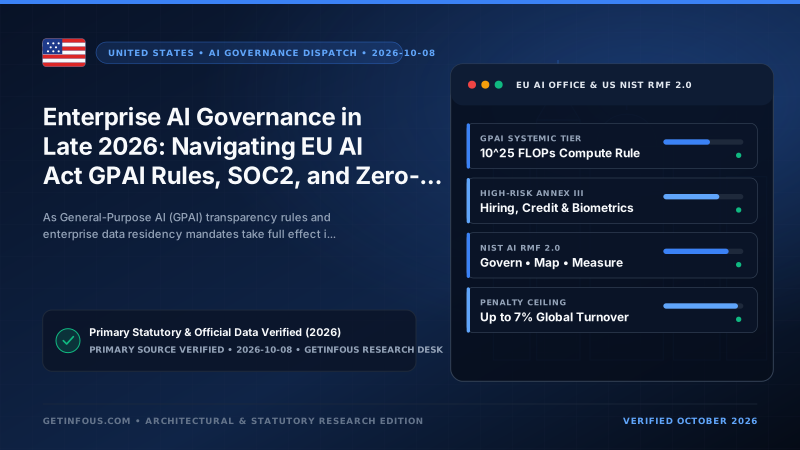
As regulatory enforcement timelines for the European Union Artificial Intelligence Act and updated United States NIST AI Risk Management Framework standards converge in late 2026, enterprise engineering and legal teams are overhauling how foundation models are procured, audited, and deployed in production. For software companies operating across North American, European, and Asia-Pacific jurisdictions, compliance is no longer a post-deployment legal checklist; it directly dictates whether a workload can use a public serverless API, requires a regional cloud VPC endpoint, or must run on self-hosted open-weights infrastructure.
Under the phased implementation of the EU AI Act, obligations governing General-Purpose AI (GPAI) models—particularly those designated as carrying systemic risk due to training compute thresholds exceeding 10^25 FLOPs—require model providers to publish standardized technical documentation, training data summaries, copyright compliance policies, and adversarial red-teaming evaluations. Downstream enterprise deployers integrating these foundation models into high-impact sectors such as financial services, healthcare triage, human resources screening, and legal document analysis face parallel requirements for human-in-the-loop oversight, audit logging, and algorithmic explainability.
In practical engineering terms, data privacy and Zero Data Retention (ZDR) agreements have become the primary dividing line during vendor selection. While consumer chat subscriptions often retain conversation histories by default to improve future model generations, enterprise API tiers from OpenAI, Anthropic, Google Cloud Vertex AI, AWS Bedrock, and Azure OpenAI now provide contractual zero-data-retention guarantees where prompts and completions are never written to persistent storage or used for weight training. Nevertheless, regulated healthcare (HIPAA) and European financial (DORA and GDPR) workloads increasingly require strict regional data residency, ensuring that inference payloads never cross sovereign cloud boundaries.
This regulatory pressure has significantly accelerated enterprise adoption of open-weights models released under permissive Apache 2.0 and MIT licenses, including Qwen3, Mistral Large, DeepSeek V3/R1, and Gemma 3. When an organization deploys an open-weights model on dedicated GPU nodes inside its own Virtual Private Cloud using vLLM, SGLang, or NVIDIA TensorRT-LLM, zero customer data leaves the corporate security perimeter. Furthermore, engineering teams can pin exact model weight checksums, guaranteeing deterministic behavior across regulatory audit cycles without the risk of a cloud provider silently deprecating or altering a hosted API checkpoint.
Yet self-hosting open-weights models does not exempt organizations from governance responsibilities. Security audits conducted throughout 2026 highlight that self-hosted deployments shift the burden of guardrails, prompt injection defense, PII redaction, and output toxicity filtering entirely onto the internal platform engineering team. Additionally, not all open-weights models share the same legal terms: while Apache 2.0 and MIT licenses grant unrestricted commercial rights, custom community licenses such as the Llama 3 and Llama 4 license frameworks impose active-user thresholds and specific naming attributions that legal departments must verify before commercial redistribution.
To streamline compliance across multi-model architectures, leading enterprises are adopting centralized AI gateway proxies. By routing all internal application traffic through a unified governance layer, organizations can enforce automated PII scrubbing before prompts reach external APIs, maintain immutable cryptographic audit logs of model inputs and outputs, enforce per-department token budget caps, and seamlessly fail over between regional cloud endpoints when latency or compliance policies require it.
Every dispatch published by the GetInfoUs Research Desk is cross-checked against primary government statutes, official provider documentation, and reproducible benchmark datasets before publication.
Related reading
Benchmark scores, token prices, and rate limits evolve rapidly as AI labs release model updates. Always verify current specifications and pricing on the official provider documentation.