Llama 3.1 70B vs Llama 3.1 405B
Benchmarks, API Token Pricing, Context Window & Speed Comparison
Related topics (12)
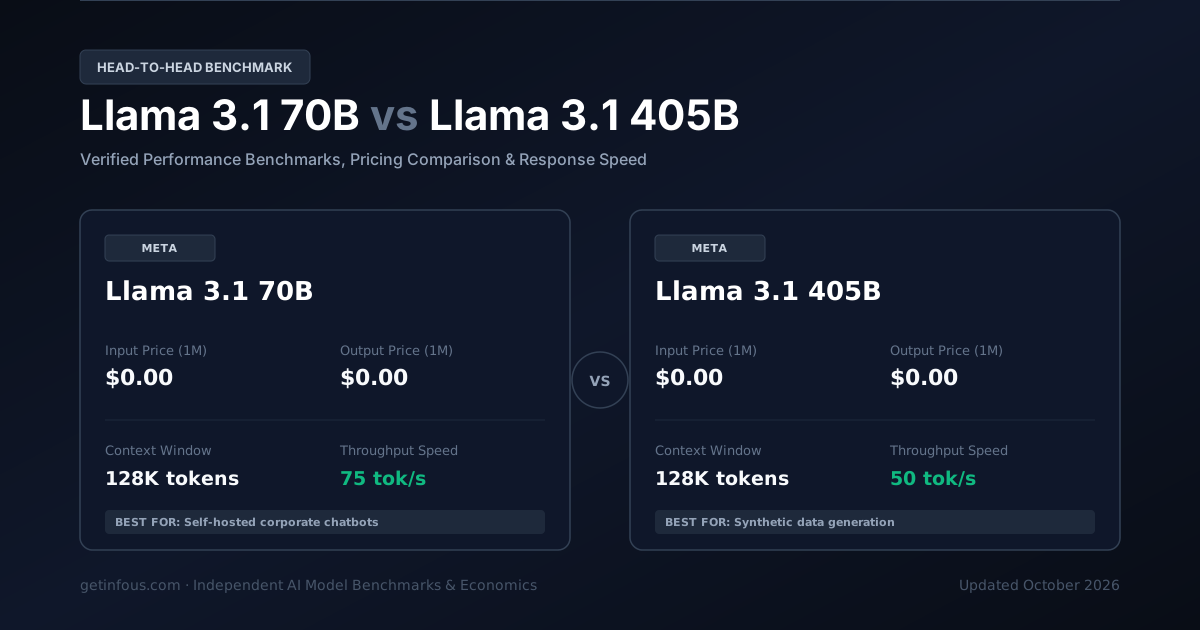
Llama 3.1 70B by Meta and Llama 3.1 405B by Meta represent two of the frontier AI models analyzed in our comprehensive 2026 AI benchmark and LLM comparison. In this head-to-head evaluation, we examine API token pricing, context window specifications, inference speed (tokens per second), and empirical reasoning performance. From a pure economic perspective, both models offer identical input token rates. On output generation, costs are matched. In data-heavy architectures requiring extensive repository or document analysis, both models provide an identical memory horizon with 128K tokens. In latency-sensitive production environments, Llama 3.1 70B leads in tokens-per-second throughput, making it ideal for real-time conversational agents and high-concurrency workflows. Below is the complete empirical head-to-head breakdown across cost, speed, context, and capability matrices.
Switch & Compare Any Models
Select any AI models from our verified benchmark database to generate live side-by-side matrices.
Llama 3.1 70B
Open WorkhorseEnterprise open-source workhorse offering competitive performance with closed frontier models across 128K context.
$0.00 / 1M
$0.00 / 1M
128K tokens
42%
Llama 3.1 405B
Frontier Open SovereignThe monumental 405-billion parameter open foundation model trained on 16K H100 GPUs, delivering true frontier parity with GPT-4o and Claude 3.5 Sonnet.
$0.00 / 1M
$0.00 / 1M
128K tokens
41.5%
Key Differences at a Glance
- Llama 3.1 70B is 1.0x cheaper for API usage (input + output tokens combined).
- Llama 3.1 70B is faster at 75 tok/s vs 50 tok/s.
- Llama 3.1 70B leads on SWE-bench coding (42.0% vs 41.5%).
| Feature | Llama 3.1 70B | Llama 3.1 405B |
|---|---|---|
Intelligence Index Composite reasoning & knowledge score (0-100) | 75 | 48 |
Provider | Meta | Meta |
Input Price Cost per million input tokens | $0.00 / 1M | $0.00 / 1M |
Output Price Cost per million output tokens | $0.00 / 1M | $0.00 / 1M |
Blended Price Weighted 7:2:1 cache:input:output per 1M | $0.00 / 1M | $0.53 / 1M |
Context Window Maximum input + output tokens | 128K tokens~192 A4 pages of text | 128K tokens~192 A4 pages of text |
Max Output Tokens Per single request | 8K | 8K |
Throughput Speed Tokens generated per second | 75 tok/s | 50 tok/s |
SWE-bench Verified Real-world software engineering | 42% | 41.5% |
GPQA Diamond Graduate-level reasoning | 52% | 53% |
Cached Input Price Prompt caching discount per 1M tokens | $0.00 / 1M | $0.75 / 1M |
Who Wins Where?
At-a-glance decision frameworkEmpirical Head-to-Head Benchmark Scores
Official evaluation metrics verified by independent third-party research labs.
Industry benchmark evaluating real-world GitHub issue resolution and multi-file debugging.
Challenging questions created by domain experts to test complex PhD-level reasoning.
Hardened reasoning and academic knowledge benchmark with reduced lucky-guess probability.
Crowdsourced human preference evaluation based on blind, head-to-head model battles.
Tokens emitted per second during active generation streaming.
Latency & Response Time
Time to first token (TTFT) and estimated end-to-end response time for a typical 500-token response.
Real-Time Interactive Token Cost Simulator
Adjust sliders to calculate projected monthly cloud API spending with prompt caching discounts.
Llama 3.1 70B · Strengths & Key Advantages
- Rivals GPT-4 class models on general knowledge and coding
- 128K context window
- Can be served on dual consumer GPUs with 4-bit quantisation
Considerations & Trade-offs
- Computationally heavy for modest hardware
- Does not feature native vision understanding
Llama 3.1 405B · Strengths & Key Advantages
- World’s largest openly downloadable foundation weights (405 billion dense parameters)
- 128,000 token context window supporting synthetic data generation and model distillation
- Empowers companies to distill custom lightweight models with zero proprietary restrictions
Considerations & Trade-offs
- Requires substantial 8xH100 server nodes to host raw weights
- Text-only without native multimodal vision understanding
Token Use & Task Economics
Estimated cost and token consumption to complete one representative agentic task.
| Metric | Llama 3.1 70B | Llama 3.1 405B |
|---|---|---|
Cost per Task Estimated USD to finish one task | $0.00 | $0.20 |
Output Tokens / Task Tokens generated per task | 6K | 24K |
Reasoning Tokens / Task Thinking tokens burned per task | 0K | 0K |
Technical Specifications
Architecture, release timeline, capabilities, and modalities.
| Feature | Llama 3.1 70B | Llama 3.1 405B |
|---|---|---|
| Official API Model ID (SDK) | meta-llama/Llama-3.1-70B | meta-llama/Llama-3.1-405B |
| API Protocol | OpenAI-Compatible REST / vLLM / SGLang / HuggingFace TGI | OpenAI-Compatible REST / vLLM / SGLang / HuggingFace TGI |
| Release Date | 2024-07 | 2024-07 |
| Knowledge Cutoff | December 2023 | December 2023 |
| Architecture | High-capacity dense multilingual transformer | World’s Largest Open Foundation Transformer |
| Parameters | 70B | 405B |
| Enterprise Rate Limits (RPM / TPM) | Unlimited (Hardware-bound on self-hosted GPU) / 10,000 RPM Cloud · Unlimited local throughput / 10M+ TPM Managed Cloud | Unlimited (Hardware-bound on self-hosted GPU) / 10,000 RPM Cloud · Unlimited local throughput / 10M+ TPM Managed Cloud |
| Long-Context Tier (>128K/200K) | Free across full context window (only KV-cache VRAM scales) | Free across full context window (only KV-cache VRAM scales) |
| Prompt Cache Policy & TTL | Automatic prefix KV-caching in vLLM / SGLang (0 cost) | Automatic prefix KV-caching in vLLM / SGLang (0 cost) |
| Computer Use / GUI Agent | API / CLI Tool-Use & DOM Agent ready (no raw pixel desktop click loop) | API / CLI Tool-Use & DOM Agent ready (no raw pixel desktop click loop) |
| MCP & Parallel Tool Calling | Native MCP Client/Server ready · Parallel function calling · 100% Strict JSON Schema | Native MCP Client/Server ready · Parallel function calling · 100% Strict JSON Schema |
| Web Search Grounding & Sandbox | Supported via external Tavily/Exa Search & E2B/Docker Sandbox tools | Supported via external Tavily/Exa Search & E2B/Docker Sandbox tools |
| Official Fine-Tuning Support | Full Weights SFT, LoRA, QLoRA, DPO & GRPO RL (Unsloth / Axolotl / Llama-Factory) | Full Weights SFT, LoRA, QLoRA, DPO & GRPO RL (Unsloth / Axolotl / Llama-Factory) |
| Multimodal Token Billing | Text BPE (~4 chars/token) | Text BPE (~4 chars/token) |
| Quantization & Min GPU VRAM | BF16 / FP16, FP8 Dynamic, INT4 AWQ / GPTQ, GGUF (Q4_K_M / Q8_0) · 43 GB VRAM (4-bit Quantized) · 151 GB VRAM (Native BF16) | BF16 / FP16, FP8 Dynamic, INT4 AWQ / GPTQ, GGUF (Q4_K_M / Q8_0) · 251 GB VRAM (4-bit Quantized) · 871 GB VRAM (Native BF16) |
| Safety & Frontier Classification | Open-Weights System Card + Customizable Guardrail Layer (Llama Guard / ShieldGemma) | Open-Weights System Card + Customizable Guardrail Layer (Llama Guard / ShieldGemma) |
| Enterprise Compliance (ZDR/HIPAA/SOC2) | 100% Air-Gapped On-Premises / Private VPC · Full HIPAA, GDPR & SOC2 Control | 100% Air-Gapped On-Premises / Private VPC · Full HIPAA, GDPR & SOC2 Control |
| Input Modalities | text | text |
| Output Modalities | text | text |
Llama 3.1 70B vs Llama 3.1 405B: Quick Answers
Which is more intelligent, Llama 3.1 70B or Llama 3.1 405B?
Llama 3.1 70B is more intelligent. It scores 75 compared with 48 on the composite Intelligence Index.
Which model is faster?
Llama 3.1 70B is faster, generating 75 tokens per second compared with 50 tokens per second.
Which model is cheaper to run?
Llama 3.1 70B is cheaper at $0.00 per 1M tokens blended, compared with $0.53 (7:2:1 cache:input:output ratio).
Which model has lower latency?
Llama 3.1 70B has lower latency, with a time to first token of 0.40s compared with 0.85s.
Verdict
Verdict & Model Selection Recommendation: Choose Llama 3.1 70B if your priority is Self-hosted corporate chatbots, private document indexing, and code generation. Its performance in demanding tasks justifies its operational token cost. Choose Llama 3.1 405B if your workflow prioritizes Synthetic data generation, smaller model distillation, national sovereign AI, and air-gapped defense labs. For large-scale batch processing or customer-facing conversational interfaces, its balance of speed and economics delivers superior ROI.
Frequently asked questions
How does Llama 3.1 70B compare to Llama 3.1 405B in API token pricing and cost per token?+
Both Llama 3.1 70B and Llama 3.1 405B are open-weights foundation models available at $0.00 direct API cost when self-hosted, or offered at identical baseline rates across major inference providers. Model selection depends on GPU deployment sizing and specialized benchmark performance rather than raw token price. Both models support prompt caching discounts of up to 90% for repeated prompt prefixes.
Which model has a larger context window: Llama 3.1 70B or Llama 3.1 405B?+
Both Llama 3.1 70B and Llama 3.1 405B offer an identical context window of 128K tokens (~96k words). Both architectures provide equal capacity for large document ingestion, multi-file codebases, and extended multi-turn conversation histories.
Which AI model is better for software engineering and coding: Llama 3.1 70B or Llama 3.1 405B?+
Llama 3.1 70B scores 42% on SWE-bench Verified while Llama 3.1 405B scores 41.5%. For autonomous software engineering and multi-file debugging, Llama 3.1 70B holds the verified benchmark lead.
What is the difference in reasoning capability and extended thinking between Llama 3.1 70B and Llama 3.1 405B?+
Llama 3.1 70B is optimized for low-latency direct generation. In contrast, Llama 3.1 405B focuses on standard fast inference.
How does inference speed (tokens per second) compare between Llama 3.1 70B and Llama 3.1 405B?+
Llama 3.1 70B generates approximately 75 tokens per second, while Llama 3.1 405B delivers 50 tokens per second. In latency-sensitive production environments, Llama 3.1 70B provides faster time-to-first-token (TTFT) and higher streaming response velocity.
Can you implement a tiered LLM routing setup combining Llama 3.1 70B and Llama 3.1 405B to optimize costs?+
Yes! Tiered multi-model routing can optimize for latency and accuracy: you can route high-frequency conversational turns and latency-sensitive queries to Llama 3.1 70B, and route deep architectural or complex reasoning queries to Llama 3.1 70B. This balanced routing strategy maximizes system throughput and answer quality.
Understand key metrics like context window, token pricing, reasoning mode, and SWE-bench scores in our comprehensive AI glossary.
Related reading
- Llama 3.1 405B vs GPT-4o: Benchmarks, Pricing & Speed ComparisonCompare
- Llama 3.1 70B vs OLMo 2 13B: Benchmarks, Pricing & Speed ComparisonCompare
- Llama 3.1 8B vs Llama 3.1 70B: Benchmarks, Pricing & Speed ComparisonCompare
- Llama 3.3 70B vs Llama 3.1 405B: Benchmarks, Pricing & Speed ComparisonCompare
- Nemotron 3 Super 120B A12B vs Llama 3.1 405B: Benchmarks, Pricing & Speed ComparisonCompare
- Aion-3.0 vs Aion-Mini: Benchmarks, Pricing & Speed ComparisonCompare
Benchmark scores, token prices, and rate limits evolve rapidly as AI labs release model updates. Always verify current specifications and pricing on the official provider documentation.
Sources: GetInfoUs Independent AI Benchmarks & Official API Specs