Claude 3 Opus vs GPT-4
Benchmarks, API Token Pricing, Context Window & Speed Comparison
Related topics (12)
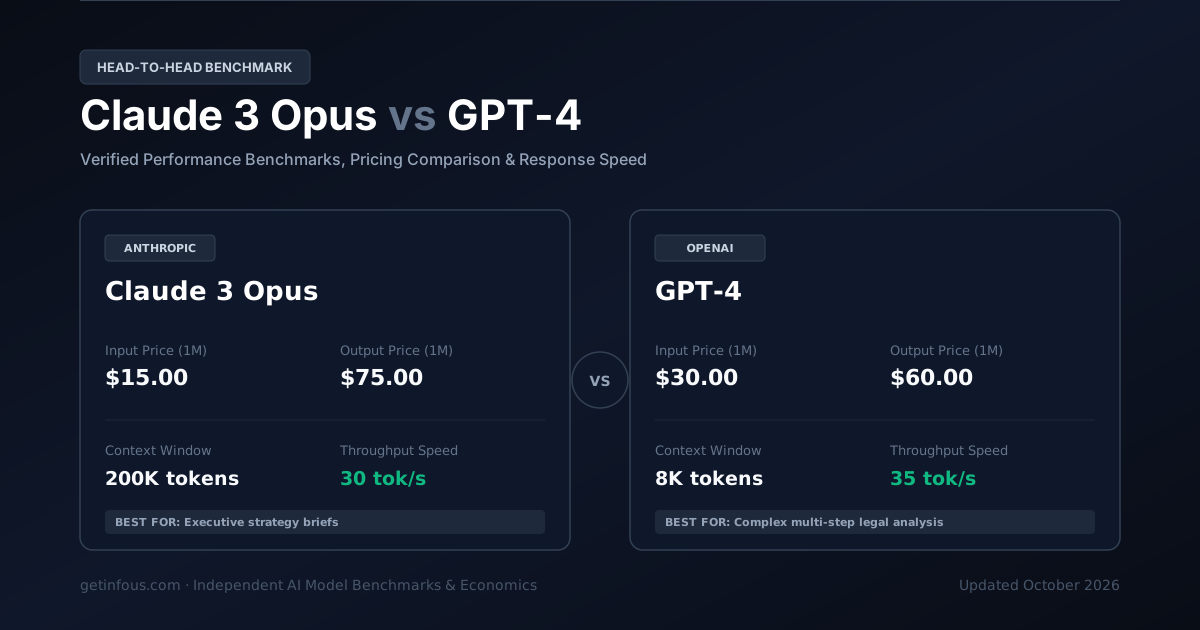
Claude 3 Opus by Anthropic and GPT-4 by OpenAI represent two of the frontier AI models analyzed in our comprehensive 2026 AI benchmark and LLM comparison. In this head-to-head evaluation, we examine API token pricing, context window specifications, inference speed (tokens per second), and empirical reasoning performance. From a pure economic perspective, Claude 3 Opus holds a notable pricing advantage for token ingestion. On output generation, GPT-4 is more economical per million generated tokens. In data-heavy architectures requiring extensive repository or document analysis, Claude 3 Opus provides an expanded memory horizon with 200K tokens. In latency-sensitive production environments, GPT-4 leads in tokens-per-second throughput, making it ideal for real-time conversational agents and high-concurrency workflows. Below is the complete empirical head-to-head breakdown across cost, speed, context, and capability matrices.
Switch & Compare Any Models
Select any AI models from our verified benchmark database to generate live side-by-side matrices.
Claude 3 Opus
Unmatched Nuance & WisdomAnthropic’s top-tier foundational intelligence model from the Claude 3 family, renowned for its extraordinary nuance, literary depth, and flawless reasoning.
$15.00 / 1M
$75.00 / 1M
200K tokens
32.2%
GPT-4
Frontier PioneerOpenAI’s historic flagship foundation model displaying human-level performance on academic examinations, professional bar exams, and complex programming challenges.
$30.00 / 1M
$60.00 / 1M
8.2K tokens
21%
Key Differences at a Glance
- Claude 3 Opus is 1.2x cheaper for API usage (input + output tokens combined).
- Claude 3 Opus has a larger context window (200K vs 8K tokens).
- GPT-4 is faster at 35 tok/s vs 30 tok/s.
- Claude 3 Opus leads on SWE-bench coding (32.2% vs 21.0%).
| Feature | Claude 3 Opus | GPT-4 |
|---|---|---|
Intelligence Index Composite reasoning & knowledge score (0-100) | 44 | 38 |
Provider | Anthropic | OpenAI |
Input Price Cost per million input tokens | $15.00 / 1M | $30.00 / 1M |
Output Price Cost per million output tokens | $75.00 / 1M | $60.00 / 1M |
Blended Price Weighted 7:2:1 cache:input:output per 1M | $11.55 / 1M | $17.25 / 1M |
Context Window Maximum input + output tokens | 200K tokens~300 A4 pages of text | 8.2K tokens~12 A4 pages of text |
Max Output Tokens Per single request | 4K | 4K |
Throughput Speed Tokens generated per second | 30 tok/s | 35 tok/s |
SWE-bench Verified Real-world software engineering | 32.2% | 21% |
GPQA Diamond Graduate-level reasoning | 50.4% | 35.8% |
Cached Input Price Prompt caching discount per 1M tokens | $1.50 / 1M | $7.50 / 1M |
Who Wins Where?
At-a-glance decision frameworkEmpirical Head-to-Head Benchmark Scores
Official evaluation metrics verified by independent third-party research labs.
Industry benchmark evaluating real-world GitHub issue resolution and multi-file debugging.
Challenging questions created by domain experts to test complex PhD-level reasoning.
Hardened reasoning and academic knowledge benchmark with reduced lucky-guess probability.
Crowdsourced human preference evaluation based on blind, head-to-head model battles.
Tokens emitted per second during active generation streaming.
Latency & Response Time
Time to first token (TTFT) and estimated end-to-end response time for a typical 500-token response.
Real-Time Interactive Token Cost Simulator
Adjust sliders to calculate projected monthly cloud API spending with prompt caching discounts.
Claude 3 Opus · Strengths & Key Advantages
- Deepest textual nuance, philosophical reasoning, and literary flair in the industry
- First model to dethrone GPT-4 on the LMSYS Chatbot Arena leaderboard in early 2024
- Exceptional vision understanding of charts, handwritten diagrams, and schematics
Considerations & Trade-offs
- Premium pricing tier ($15/$75 per 1M tokens)
- Lower generation speed (30 tok/s) compared to Claude 3.5 Sonnet
GPT-4 · Strengths & Key Advantages
- Passed uniform bar exam in top 10th percentile and high school Olympiads
- First large-scale multimodal foundation model demonstrating diagram interpretation
- Superior complex instruction following and policy compliance
Considerations & Trade-offs
- High API cost ($30/$60 per 1M tokens) compared to modern optimized descendants
- Slow inference speed (35 tok/s) and limited 8K default context
Token Use & Task Economics
Estimated cost and token consumption to complete one representative agentic task.
| Metric | Claude 3 Opus | GPT-4 |
|---|---|---|
Cost per Task Estimated USD to finish one task | $0.20 | $0.20 |
Output Tokens / Task Tokens generated per task | 24K | 24K |
Reasoning Tokens / Task Thinking tokens burned per task | 0K | 0K |
Technical Specifications
Architecture, release timeline, capabilities, and modalities.
| Feature | Claude 3 Opus | GPT-4 |
|---|---|---|
| Official API Model ID (SDK) | claude-3-opus-20240301 | gpt-4 |
| API Protocol | Anthropic Messages API + AWS Bedrock + Vertex AI | OpenAI Responses API & Chat Completions v1 |
| Release Date | 2024-03 | 2023-03 |
| Knowledge Cutoff | August 2023 | September 2021 |
| Architecture | Frontier Dense Multimodal Transformer | Mixture-of-Experts (MoE) |
| Parameters | Confidential | Confidential (est. 1.8T MoE) |
| Enterprise Rate Limits (RPM / TPM) | 4,000 – 10,000 RPM (Tier 4 + Priority Tier) · 800,000 – 2,000,000 TPM | 10,000 – 30,000 RPM (Tier 5 Enterprise) · 800,000 – 2,000,000 TPM |
| Long-Context Tier (>128K/200K) | Standard rate up to 200K tokens; 2x input/output tier above 200K tokens | Flat rate ($30/1M in) across full 8K window |
| Prompt Cache Policy & TTL | $1.5/1M cached read (90% off); 5-min default & 1-hour extended TTL | Automatic prefix caching at $7.5/1M (no extra cache-write fee) |
| Computer Use / GUI Agent | Supported (Screen coordinate grounding, browser & desktop GUI action loops) | API / CLI Tool-Use & DOM Agent ready (no raw pixel desktop click loop) |
| MCP & Parallel Tool Calling | Native MCP Client/Server ready · Parallel function calling · 100% Strict JSON Schema | Native MCP Client/Server ready · Parallel function calling · 100% Strict JSON Schema |
| Web Search Grounding & Sandbox | Native Web Search Citations + Code Execution Tool + MCP Connectors | Native Web Search tool + Hosted Code Interpreter & File Search RAG |
| Official Fine-Tuning Support | Custom Model Tuning via Amazon Bedrock & Prompt Distillation | Supervised Fine-Tuning (SFT), Direct Preference (DPO) & Reinforcement Fine-Tuning (RFT) |
| Multimodal Token Billing | Text BPE (~4 chars/token) · Vision (~258–765 tokens per image tile) | Text BPE (~4 chars/token) |
| Quantization & Min GPU VRAM | Cloud-Hosted Proprietary (FP8 / BF16 Tensor Core Cluster) · Zero Local VRAM Required (100% Serverless Cloud API) | Cloud-Hosted Proprietary (FP8 / BF16 Tensor Core Cluster) · Zero Local VRAM Required (100% Serverless Cloud API) |
| Safety & Frontier Classification | Anthropic RSP ASL-2 / ASL-3 Constitutional Safety Evaluated | OpenAI Preparedness Framework Audited & System Card Published |
| Enterprise Compliance (ZDR/HIPAA/SOC2) | SOC2 Type II · GDPR · Zero Data Retention (ZDR) & HIPAA BAA Available on Enterprise Tier | SOC2 Type II · GDPR · Zero Data Retention (ZDR) & HIPAA BAA Available on Enterprise Tier |
| Input Modalities | text, vision | text |
| Output Modalities | text | text |
Claude 3 Opus vs GPT-4: Quick Answers
Which is more intelligent, Claude 3 Opus or GPT-4?
Claude 3 Opus is more intelligent. It scores 44 compared with 38 on the composite Intelligence Index.
Which model is faster?
GPT-4 is faster, generating 35 tokens per second compared with 30 tokens per second.
Which model is cheaper to run?
Claude 3 Opus is cheaper at $11.55 per 1M tokens blended, compared with $17.25 (7:2:1 cache:input:output ratio).
Which model has a larger context window?
Claude 3 Opus has a larger context window, supporting 200K tokens compared with 8.2K tokens.
Verdict
Verdict & Model Selection Recommendation: Choose Claude 3 Opus if your priority is Executive strategy briefs, high-end creative writing, philosophical research, and nuanced legal evaluation. Its performance in demanding tasks justifies its operational token cost. Choose GPT-4 if your workflow prioritizes Complex multi-step legal analysis, nuanced philosophical debate, and academic benchmark research. For large-scale batch processing or customer-facing conversational interfaces, its balance of speed and economics delivers superior ROI.
Frequently asked questions
How does Claude 3 Opus compare to GPT-4 in API token pricing and cost per token?+
Claude 3 Opus costs $15.00 per 1M input tokens and $75.00 per 1M output tokens, whereas GPT-4 costs $30.00 input and $60.00 output. Overall, Claude 3 Opus is the more cost-effective model for high-volume API pipelines. Both models support prompt caching discounts of up to 90% for repeated prompt prefixes.
Which model has a larger context window: Claude 3 Opus or GPT-4?+
Claude 3 Opus supports a context window of 200K tokens (~150k words), while GPT-4 supports 8K tokens (~6k words). Therefore, Claude 3 Opus can process more textual data and document context in a single prompt.
Which AI model is better for software engineering and coding: Claude 3 Opus or GPT-4?+
Claude 3 Opus scores 32.2% on SWE-bench Verified while GPT-4 scores 21%. For autonomous software engineering and multi-file debugging, Claude 3 Opus holds the verified benchmark lead.
What is the difference in reasoning capability and extended thinking between Claude 3 Opus and GPT-4?+
Claude 3 Opus is optimized for low-latency direct generation. In contrast, GPT-4 focuses on standard fast inference.
How does inference speed (tokens per second) compare between Claude 3 Opus and GPT-4?+
Claude 3 Opus generates approximately 30 tokens per second, while GPT-4 delivers 35 tokens per second. In latency-sensitive production environments, GPT-4 provides faster time-to-first-token (TTFT) and higher streaming response velocity.
Can you implement a tiered LLM routing setup combining Claude 3 Opus and GPT-4 to optimize costs?+
Yes! High-efficiency architectures route high-frequency routine classification and conversational tasks to Claude 3 Opus to save operational costs, and dynamically escalate complex architectural queries or reasoning tasks to GPT-4. This tiered routing pattern cuts overall API bills by up to 70%.
Understand key metrics like context window, token pricing, reasoning mode, and SWE-bench scores in our comprehensive AI glossary.
Related reading
- Claude 3.5 Sonnet vs Claude 3 Opus: Benchmarks, Pricing & Speed ComparisonCompare
- Gemini 1.5 Pro vs Claude 3 Opus: Benchmarks, Pricing & Speed ComparisonCompare
- GPT-4 vs GPT-3.5 Turbo: Benchmarks, Pricing & Speed ComparisonCompare
- GPT-4 vs GPT-3: Benchmarks, Pricing & Speed ComparisonCompare
- GPT-4 vs GPT-4 Turbo: Benchmarks, Pricing & Speed ComparisonCompare
- Qwen-VL Plus vs Claude 3 Opus: Benchmarks, Pricing & Speed ComparisonCompare
Benchmark scores, token prices, and rate limits evolve rapidly as AI labs release model updates. Always verify current specifications and pricing on the official provider documentation.
Sources: GetInfoUs Independent AI Benchmarks & Official API Specs