Command R7B Arabic vs Command R7B
Benchmarks, API Token Pricing, Context Window & Speed Comparison
Related topics (12)
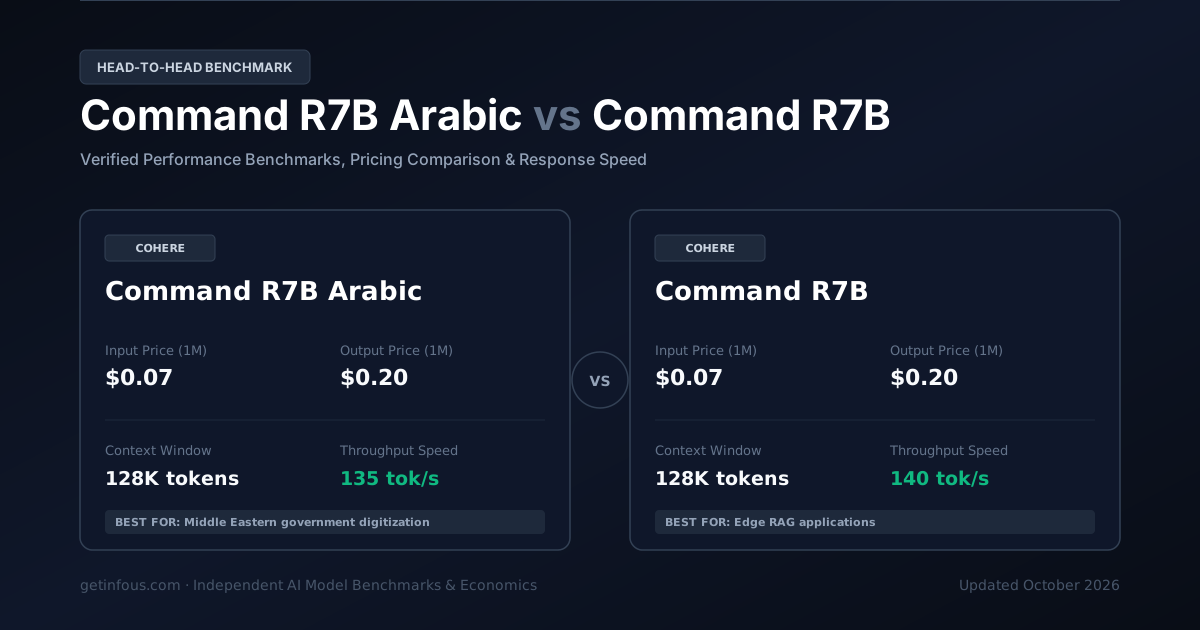
Command R7B Arabic von Cohere und Command R7B von Cohere gehören zu den führenden KI-Modellen. Command R7B Arabic bietet ein Kontextfenster von 128K Tokens bei API-Preisen von $0.07/$0.20 pro 1M Tokens, während Command R7B 128K Tokens Kontext zu $0.07/$0.20 pro 1M Tokens bereitstellt. Hier finden Sie den vollständigen Benchmark-, Latenz- und Kostenvergleich.
Beliebige Modelle wechseln & vergleichen
Select any AI models from our verified benchmark database to generate live side-by-side matrices.
Command R7B Arabic
Open-Weights-BasismodellCommand R7B Arabic von Cohere ist ein KI-Modell für Self-Hosting im eigenen Rechenzentrum, Fine-Tuning und volle Datensouveränität mit 128K Kontextfenster, 135 Token/s Durchsatz, einem Intelligenz-Index von 39/100 und $0.07/$0.2 pro 1M Toke
$0.07 / 1M
$0.20 / 1M
128K tokens
26%
Command R7B
Open-Weights-BasismodellCommand R7B von Cohere ist ein KI-Modell für Self-Hosting im eigenen Rechenzentrum, Fine-Tuning und volle Datensouveränität mit 128K Kontextfenster, 140 Token/s Durchsatz, einem Intelligenz-Index von 38/100 und $0.07/$0.2 pro 1M Token.
$0.07 / 1M
$0.20 / 1M
128K tokens
27%
Wichtigste Unterschiede auf einen Blick
- Both models cost the same under this workload — choose on capability, not price.
- Command R7B is faster at 140 tok/s vs 135 tok/s.
- Command R7B leads on SWE-bench coding (27.0% vs 26.0%).
| Feature | Command R7B Arabic | Command R7B |
|---|---|---|
Intelligence Index Composite reasoning & knowledge score (0-100) | 39 | 38 |
Provider | Cohere | Cohere |
Input Price Cost per million input tokens | $0.07 / 1M | $0.07 / 1M |
Output Price Cost per million output tokens | $0.20 / 1M | $0.20 / 1M |
Blended Price Weighted 7:2:1 cache:input:output per 1M | $0.05 / 1M | $0.05 / 1M |
Context Window Maximum input + output tokens | 128K tokens~192 A4 pages of text | 128K tokens~192 A4 pages of text |
Max Output Tokens Per single request | 4K | 4K |
Throughput Speed Tokens generated per second | 135 tok/s | 140 tok/s |
SWE-bench Verified Real-world software engineering | 26% | 27% |
GPQA Diamond Graduate-level reasoning | 43% | 42.5% |
Cached Input Price Prompt caching discount per 1M tokens | $0.02 / 1M | $0.02 / 1M |
Wer gewinnt in welcher Disziplin?
At-a-glance decision frameworkGeprüfte Benchmark-Ergebnisse im Vergleich
Official evaluation metrics verified by independent third-party research labs.
Industry benchmark evaluating real-world GitHub issue resolution and multi-file debugging.
Challenging questions created by domain experts to test complex PhD-level reasoning.
Hardened reasoning and academic knowledge benchmark with reduced lucky-guess probability.
Crowdsourced human preference evaluation based on blind, head-to-head model battles.
Accuracy when reasoning over very large inputs that fill the model context window.
Tokens emitted per second during active generation streaming.
Latenz & Antwortzeit
Time to first token (TTFT) and estimated end-to-end response time for a typical 500-token response.
Interaktiver Token-Kosten-Simulator
Adjust sliders to calculate projected monthly cloud API spending with prompt caching discounts.
Command R7B Arabic · Strengths & Key Advantages
- 128K Kontextfenster und bis zu 4K maximale Output-Token (SWE-bench Verified 26% · GPQA Diamond 43%)
- Hohe Generierungsgeschwindigkeit von 135 Token/Sekunde bei nur 310 ms Erstlatenz (TTFT)
- Offene Modellgewichte (7B) für lokales Self-Hosting und Fine-Tuning über vLLM, SGLang oder Ollama
Considerations & Trade-offs
- Erfordert dedizierte GPU-Hardware mit ausreichend VRAM für den lokalen Betrieb in voller Präzision
- Bei extrem komplexen mehrstufigen Forschungsfragen bieten schwere Reasoning-Spezialmodelle noch tiefere Analysen
Command R7B · Strengths & Key Advantages
- 128K Kontextfenster und bis zu 4K maximale Output-Token (SWE-bench Verified 27% · GPQA Diamond 42.5%)
- Hohe Generierungsgeschwindigkeit von 140 Token/Sekunde bei nur 290 ms Erstlatenz (TTFT)
- Offene Modellgewichte (7B) für lokales Self-Hosting und Fine-Tuning über vLLM, SGLang oder Ollama
Considerations & Trade-offs
- Erfordert dedizierte GPU-Hardware mit ausreichend VRAM für den lokalen Betrieb in voller Präzision
- Bei extrem komplexen mehrstufigen Forschungsfragen bieten schwere Reasoning-Spezialmodelle noch tiefere Analysen
Token Use & Task Economics
Estimated cost and token consumption to complete one representative agentic task.
| Metric | Command R7B Arabic | Command R7B |
|---|---|---|
Cost per Task Estimated USD to finish one task | $0.05 | $0.05 |
Output Tokens / Task Tokens generated per task | 20K | 20K |
Reasoning Tokens / Task Thinking tokens burned per task | 0K | 0K |
Technische Spezifikationen
Architecture, release timeline, capabilities, and modalities.
| Feature | Command R7B Arabic | Command R7B |
|---|---|---|
| Official API Model ID (SDK) | command-r7b-arabic | command-r7b |
| API Protocol | OpenAI-Compatible REST / vLLM / SGLang / HuggingFace TGI | OpenAI-Compatible REST / vLLM / SGLang / HuggingFace TGI |
| Release Date | 2025-02 | 2024-12 |
| Knowledge Cutoff | December 2024 | October 2024 |
| Architecture | Arabic-Specialized RAG Transformer | Efficient Compact RAG Transformer |
| Parameters | 7B | 7B |
| Enterprise Rate Limits (RPM / TPM) | Unlimited (Hardware-bound on self-hosted GPU) / 10,000 RPM Cloud · Unlimited local throughput / 10M+ TPM Managed Cloud | Unlimited (Hardware-bound on self-hosted GPU) / 10,000 RPM Cloud · Unlimited local throughput / 10M+ TPM Managed Cloud |
| Long-Context Tier (>128K/200K) | Flat rate ($0.07/1M in) across full 128K window | Flat rate ($0.07/1M in) across full 128K window |
| Prompt Cache Policy & TTL | Cached input at $0.02/1M tokens | Cached input at $0.02/1M tokens |
| Computer Use / GUI Agent | API / CLI Tool-Use & DOM Agent ready (no raw pixel desktop click loop) | API / CLI Tool-Use & DOM Agent ready (no raw pixel desktop click loop) |
| MCP & Parallel Tool Calling | Native MCP Client/Server ready · Parallel function calling · 100% Strict JSON Schema | Native MCP Client/Server ready · Parallel function calling · 100% Strict JSON Schema |
| Web Search Grounding & Sandbox | Supported via external Tavily/Exa Search & E2B/Docker Sandbox tools | Supported via external Tavily/Exa Search & E2B/Docker Sandbox tools |
| Official Fine-Tuning Support | Full Weights SFT, LoRA, QLoRA, DPO & GRPO RL (Unsloth / Axolotl / Llama-Factory) | Full Weights SFT, LoRA, QLoRA, DPO & GRPO RL (Unsloth / Axolotl / Llama-Factory) |
| Multimodal Token Billing | Text BPE (~4 chars/token) | Text BPE (~4 chars/token) |
| Quantization & Min GPU VRAM | BF16 / FP16, FP8 Dynamic, INT4 AWQ / GPTQ, GGUF (Q4_K_M / Q8_0) · 4 GB VRAM (4-bit Quantized) · 15 GB VRAM (Native BF16) | BF16 / FP16, FP8 Dynamic, INT4 AWQ / GPTQ, GGUF (Q4_K_M / Q8_0) · 4 GB VRAM (4-bit Quantized) · 15 GB VRAM (Native BF16) |
| Safety & Frontier Classification | Open-Weights System Card + Customizable Guardrail Layer (Llama Guard / ShieldGemma) | Open-Weights System Card + Customizable Guardrail Layer (Llama Guard / ShieldGemma) |
| Enterprise Compliance (ZDR/HIPAA/SOC2) | 100% Air-Gapped On-Premises / Private VPC · Full HIPAA, GDPR & SOC2 Control | 100% Air-Gapped On-Premises / Private VPC · Full HIPAA, GDPR & SOC2 Control |
| Input Modalities | text | text |
| Output Modalities | text | text |
Command R7B Arabic vs Command R7B: Schnelle Antworten (FAQ)
Which is more intelligent, Command R7B Arabic or Command R7B?
Command R7B Arabic is more intelligent. It scores 39 compared with 38 on the composite Intelligence Index.
Which model is faster?
Command R7B is faster, generating 140 tokens per second compared with 135 tokens per second.
Which model has lower latency?
Command R7B has lower latency, with a time to first token of 0.29s compared with 0.31s.
Fazit
Sowohl Command R7B Arabic (Optimal für Self-Hosting im eigenen Rechenzentrum, Fine-Tuning und volle Datensouveränität, Enterprise-RAG-Systeme und skalierbare API-Pipelines.) als auch Command R7B (Optimal für Self-Hosting im eigenen Rechenzentrum, Fine-Tuning und volle Datensouveränität, Enterprise-RAG-Systeme und skalierbare API-Pipelines.) überzeugen im Produktionseinsatz: Command R7B Arabic führt bei komplexem Reasoning und Coding, Command R7B liefert den höheren Token-Durchsatz und Command R7B Arabic ist die kosteneffizienteste Wahl für große API-Workloads.
Häufig gestellte Fragen (FAQ)
Welches Modell ist besser für Coding und Reasoning – Command R7B Arabic oder Command R7B?+
Im Gesamt-Intelligenzindex und bei Software-Benchmarks liegt Command R7B Arabic vorn. Prüfen Sie oben die SWE-bench- und GPQA-Werte für Ihren Anwendungsfall.
Wie unterscheiden sich die API-Preise von Command R7B Arabic und Command R7B?+
Command R7B Arabic kostet $0.07 / $0.20 pro 1M Input-/Output-Tokens, Command R7B liegt bei $0.07 / $0.20. Beim gewichteten Gesamtpreis ist Command R7B Arabic günstiger.
Welches Modell hat das größere Kontextfenster und die höhere Geschwindigkeit?+
Command R7B Arabic bietet 128K Tokens Kontext gegenüber 128K Tokens bei Command R7B. Bei der Generierungsgeschwindigkeit liegt Command R7B vorn.
Understand key metrics like context window, token pricing, reasoning mode, and SWE-bench scores in our comprehensive AI glossary.
Related reading
- Aya Vision 8B vs. Command R7B Arabic: Benchmarks, API-Preise & Geschwindigkeit im Vergleich (2026)Vergleich
- Command R7B Arabic vs. Mistral Small 3: Benchmarks, API-Preise & Geschwindigkeit im Vergleich (2026)Vergleich
- Command R7B vs. Aya Expanse 32B: Benchmarks, API-Preise & Geschwindigkeit im Vergleich (2026)Vergleich
- Command R7B vs. Llama 3.3 70B: Benchmarks, API-Preise & Geschwindigkeit im Vergleich (2026)Vergleich
- Falcon 3 180B vs. Command R7B: Benchmarks, API-Preise & Geschwindigkeit im Vergleich (2026)Vergleich
- Phi-4 Multimodal vs. Command R7B Arabic: Benchmarks, API-Preise & Geschwindigkeit im Vergleich (2026)Vergleich
Benchmark scores, token prices, and rate limits evolve rapidly as AI labs release model updates. Always verify current specifications and pricing on the official provider documentation.
Offizielle Quellen: Offizielle API-Dokumentation von Cohere und Cohere, Systemkarten und unabhängige Benchmark-Auswertungen (2026).