GPT-5 nano vs Claude Haiku 4.5
Benchmarks, API Token Pricing, Context Window & Speed Comparison
Related topics (12)
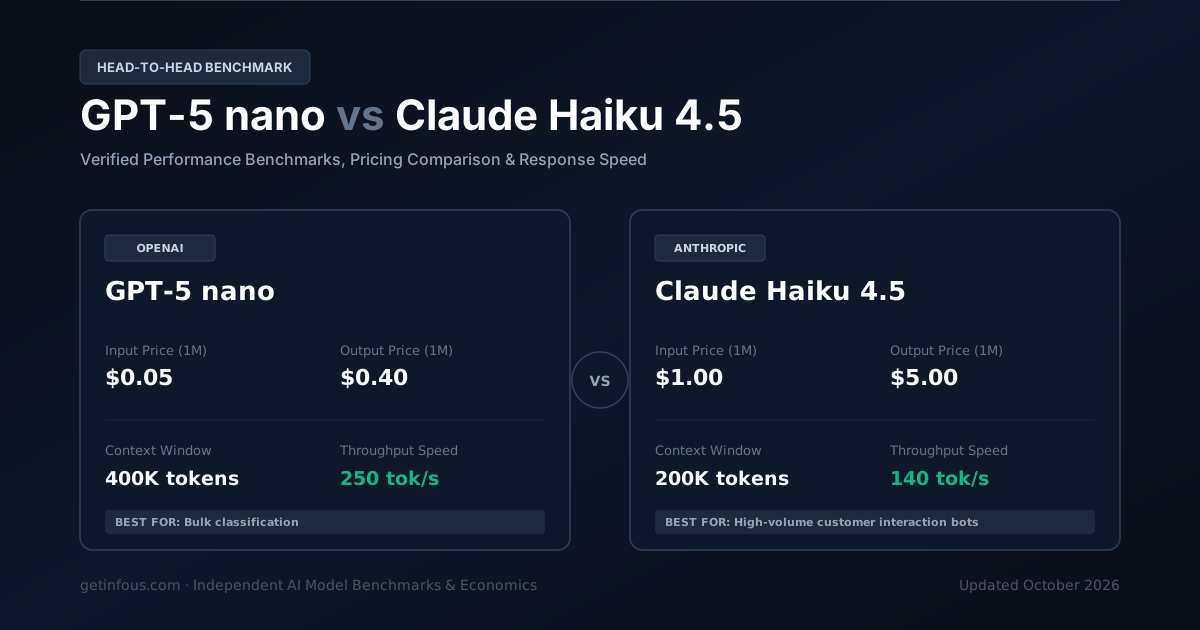
OpenAI tarafından geliştirilen GPT-5 nano ve Anthropic tarafından sunulan Claude Haiku 4.5, kendi sınıflarının öne çıkan yapay zeka modelleridir. GPT-5 nano, 400K token bağlam penceresi ve 1M token başına $0.05/$0.40 fiyat sunarken; Claude Haiku 4.5, 200K token bağlam penceresi ve $1.00/$5.00 fiyatla gelir. Aşağıda tüm benchmark, hız ve maliyet detaylarını inceleyebilirsiniz.
İstediğiniz Modelleri Seçin ve Karşılaştırın
Select any AI models from our verified benchmark database to generate live side-by-side matrices.
GPT-5 nano
Hafif ve Ekonomik ModelOpenAI tarafından geliştirilen GPT-5 nano; token başına maksimum maliyet verimliliği ve hızlı üretim çıkarımı için tasarlanmış olup 400K bağlam penceresi, 250 token/sn hız, 35/100 zeka indeksi ve 1M token başına $0.05/$0.4 fiyatlandırma sun
$0.05 / 1M
$0.40 / 1M
400K tokens
34.5%
Claude Haiku 4.5
Ultra Hızlı Düşük GecikmeAnthropic tarafından geliştirilen Claude Haiku 4.5; ultra düşük gecikmeli gerçek zamanlı sohbet ve yüksek hacimli yönlendirme için tasarlanmış olup 200K bağlam penceresi, 140 token/sn hız, 54/100 zeka indeksi ve 1M token başına $1/$5 fiyatl
$1.00 / 1M
$5.00 / 1M
200K tokens
58.2%
Bir Bakışta Temel Farklar
- GPT-5 nano is 13.9x cheaper for API usage (input + output tokens combined).
- GPT-5 nano has a larger context window (400K vs 200K tokens).
- GPT-5 nano is faster at 250 tok/s vs 140 tok/s.
- Claude Haiku 4.5 leads on SWE-bench coding (58.2% vs 34.5%).
| Feature | GPT-5 nano | Claude Haiku 4.5 |
|---|---|---|
Intelligence Index Composite reasoning & knowledge score (0-100) | 35 | 54 |
Provider | OpenAI | Anthropic |
Input Price Cost per million input tokens | $0.05 / 1M | $1.00 / 1M |
Output Price Cost per million output tokens | $0.40 / 1M | $5.00 / 1M |
Blended Price Weighted 7:2:1 cache:input:output per 1M | $0.05 / 1M | $0.77 / 1M |
Context Window Maximum input + output tokens | 400K tokens~600 A4 pages of text | 200K tokens~300 A4 pages of text |
Max Output Tokens Per single request | 128K | 64K |
Throughput Speed Tokens generated per second | 250 tok/s | 140 tok/s |
SWE-bench Verified Real-world software engineering | 34.5% | 58.2% |
GPQA Diamond Graduate-level reasoning | 48% | 62.1% |
Cached Input Price Prompt caching discount per 1M tokens | $0.01 / 1M | $0.10 / 1M |
Hangi Alanda Kim Kazanıyor?
At-a-glance decision frameworkDoğrulanmış Benchmark Puanları
Official evaluation metrics verified by independent third-party research labs.
Industry benchmark evaluating real-world GitHub issue resolution and multi-file debugging.
Challenging questions created by domain experts to test complex PhD-level reasoning.
Hardened reasoning and academic knowledge benchmark with reduced lucky-guess probability.
Crowdsourced human preference evaluation based on blind, head-to-head model battles.
Extremely difficult, closed-ended questions spanning the frontier of human expert knowledge.
Autonomous multi-step tasks executed inside a real command-line terminal environment.
Research-grade coding problems drawn from real scientific and numerical workloads.
Contamination-free competitive programming problems collected continuously over time.
American Invitational Mathematics Examination — multi-step Olympiad-level reasoning.
Accuracy when reasoning over very large inputs that fill the model context window.
Tokens emitted per second during active generation streaming.
Gecikme Süresi ve Yanıt Hızı
Time to first token (TTFT) and estimated end-to-end response time for a typical 500-token response.
Gerçek Zamanlı Token Maliyet Simülatörü
Adjust sliders to calculate projected monthly cloud API spending with prompt caching discounts.
GPT-5 nano · Strengths & Key Advantages
- 400K bağlam penceresi ve yanıt başına maksimum 128K çıktı tokenı kapasitesi (SWE-bench Verified 34.5% · GPQA Diamond 48%)
- Sadece 380 ms ilk token gecikmesi (TTFT) ile saniyede 250 token yüksek üretim hızı
- İstem önbellekleme (Prompt Caching), araç çağırma ve yapılandırılmış JSON çıktısını destekleyen rekabetçi API ekonomisi (1M token başına $0.05/$0.4 fiyatlandırma)
Considerations & Trade-offs
- Kapalı ağırlıklı bulut modelidir; çevrimdışı yerel sunuculara indirilerek çalıştırılamaz
- Çok karmaşık akademik ve bilimsel çıkarımlarda üst düzey ağır akıl yürütme modelleri daha derin sonuçlar verebilir
Claude Haiku 4.5 · Strengths & Key Advantages
- 200K bağlam penceresi ve yanıt başına maksimum 64K çıktı tokenı kapasitesi (SWE-bench Verified 58.2% · GPQA Diamond 62.1%)
- Sadece 280 ms ilk token gecikmesi (TTFT) ile saniyede 140 token yüksek üretim hızı
- İstem önbellekleme (Prompt Caching), araç çağırma ve yapılandırılmış JSON çıktısını destekleyen rekabetçi API ekonomisi (1M token başına $1/$5 fiyatlandırma)
Considerations & Trade-offs
- Kapalı ağırlıklı bulut modelidir; çevrimdışı yerel sunuculara indirilerek çalıştırılamaz
- Çok karmaşık akademik ve bilimsel çıkarımlarda üst düzey ağır akıl yürütme modelleri daha derin sonuçlar verebilir
Token Use & Task Economics
Estimated cost and token consumption to complete one representative agentic task.
| Metric | GPT-5 nano | Claude Haiku 4.5 |
|---|---|---|
Cost per Task Estimated USD to finish one task | $0.06 | $0.70 |
Output Tokens / Task Tokens generated per task | 42K | 20K |
Reasoning Tokens / Task Thinking tokens burned per task | 18K | 10K |
Teknik Özellikler
Architecture, release timeline, capabilities, and modalities.
| Feature | GPT-5 nano | Claude Haiku 4.5 |
|---|---|---|
| Official API Model ID (SDK) | gpt-5-nano | claude-haiku-4-5-20251001 |
| API Protocol | OpenAI Responses API & Chat Completions v1 | Anthropic Messages API + AWS Bedrock + Vertex AI |
| Release Date | 2025-08 | 2025-10 |
| Knowledge Cutoff | September 2024 | July 2025 |
| Architecture | Nano unified reasoning model | Lightweight High-Speed Multimodal Transformer |
| Parameters | Confidential | Confidential |
| Enterprise Rate Limits (RPM / TPM) | 10,000 – 30,000 RPM (Tier 5 Enterprise) · 800,000 – 2,000,000 TPM | 4,000 – 10,000 RPM (Tier 4 + Priority Tier) · 800,000 – 2,000,000 TPM |
| Long-Context Tier (>128K/200K) | Flat rate ($0.05/1M in) across full 400K window | Standard rate up to 200K tokens; 2x input/output tier above 200K tokens |
| Prompt Cache Policy & TTL | Automatic prefix caching at $0.005/1M (no extra cache-write fee) | $0.1/1M cached read (90% off); 5-min default & 1-hour extended TTL |
| Computer Use / GUI Agent | Supported (Screen coordinate grounding, browser & desktop GUI action loops) | Supported (Screen coordinate grounding, browser & desktop GUI action loops) |
| MCP & Parallel Tool Calling | Native MCP Client/Server ready · Parallel function calling · 100% Strict JSON Schema | Native MCP Client/Server ready · Parallel function calling · 100% Strict JSON Schema |
| Web Search Grounding & Sandbox | Native Web Search tool + Hosted Code Interpreter & File Search RAG | Native Web Search Citations + Code Execution Tool + MCP Connectors |
| Official Fine-Tuning Support | Supervised Fine-Tuning (SFT), Direct Preference (DPO) & Reinforcement Fine-Tuning (RFT) | Custom Model Tuning via Amazon Bedrock & Prompt Distillation |
| Multimodal Token Billing | Text BPE (~4 chars/token) · Vision (~258–765 tokens per image tile) | Text BPE (~4 chars/token) · Vision (~258–765 tokens per image tile) |
| Quantization & Min GPU VRAM | Cloud-Hosted Proprietary (FP8 / BF16 Tensor Core Cluster) · Zero Local VRAM Required (100% Serverless Cloud API) | Cloud-Hosted Proprietary (FP8 / BF16 Tensor Core Cluster) · Zero Local VRAM Required (100% Serverless Cloud API) |
| Safety & Frontier Classification | OpenAI Preparedness Framework Audited & System Card Published | Anthropic RSP ASL-2 / ASL-3 Constitutional Safety Evaluated |
| Enterprise Compliance (ZDR/HIPAA/SOC2) | SOC2 Type II · GDPR · Zero Data Retention (ZDR) & HIPAA BAA Available on Enterprise Tier | SOC2 Type II · GDPR · Zero Data Retention (ZDR) & HIPAA BAA Available on Enterprise Tier |
| Input Modalities | text, vision | text, vision |
| Output Modalities | text | text |
GPT-5 nano vs Claude Haiku 4.5: Hızlı Yanıtlar (SSS)
Which is more intelligent, GPT-5 nano or Claude Haiku 4.5?
Claude Haiku 4.5 is more intelligent. It scores 54 compared with 35 on the composite Intelligence Index.
Which model is faster?
GPT-5 nano is faster, generating 250 tokens per second compared with 140 tokens per second.
Which model is cheaper to run?
GPT-5 nano is cheaper at $0.05 per 1M tokens blended, compared with $0.77 (7:2:1 cache:input:output ratio).
Which model has lower latency?
Claude Haiku 4.5 has lower latency, with a time to first token of 0.28s compared with 0.38s.
Which model has a larger context window?
GPT-5 nano has a larger context window, supporting 400K tokens compared with 200K tokens.
Sonuç
Hem GPT-5 nano (token başına maksimum maliyet verimliliği ve hızlı üretim çıkarımı, kurumsal RAG mimarileri ve ölçeklenebilir üretim API entegrasyonları için idealdir.) hem de Claude Haiku 4.5 (ultra düşük gecikmeli gerçek zamanlı sohbet ve yüksek hacimli yönlendirme, kurumsal RAG mimarileri ve ölçeklenebilir üretim API entegrasyonları için idealdir.) güçlü üretim seçenekleridir: Claude Haiku 4.5 karmaşık akıl yürütme ve kodlama testlerinde öne çıkarken, GPT-5 nano daha yüksek üretim hızı sağlar; GPT-5 nano ise yüksek hacimli API kullanımlarında daha ekonomiktir.
Sıkça Sorulan Sorular (SSS)
Kodlama ve akıl yürütme için GPT-5 nano mi yoksa Claude Haiku 4.5 mi daha iyi?+
Bileşik zeka endeksi ve yazılım testlerinde Claude Haiku 4.5 önde yer alıyor. Detaylı karşılaştırma için yukarıdaki SWE-bench ve GPQA tablolarına göz atabilirsiniz.
GPT-5 nano ve Claude Haiku 4.5 API fiyatları nasıl karşılaştırılır?+
GPT-5 nano 1M giriş/çıkış tokeni başına $0.05 / $0.40 ücretlendirilirken, Claude Haiku 4.5 $1.00 / $5.00 seviyesindedir. Karma maliyette GPT-5 nano daha avantajlıdır.
Hangi modelin bağlam penceresi daha geniş ve hızı daha yüksek?+
GPT-5 nano 400K token bağlam penceresi sunarken Claude Haiku 4.5 200K token kapasiteye sahiptir. Saniyedeki token üretim hızında ise GPT-5 nano öndedir.
Understand key metrics like context window, token pricing, reasoning mode, and SWE-bench scores in our comprehensive AI glossary.
Related reading
- Claude Haiku 4.5 vs GPT-5 Chat: Benchmark, API Fiyatları ve Hız Karşılaştırması (2026)Karşılaştır
- Claude Sonnet 4.5 vs Claude Haiku 4.5: Benchmark, API Fiyatları ve Hız Karşılaştırması (2026)Karşılaştır
- GPT-5 mini vs Claude Haiku 4.5: Benchmark, API Fiyatları ve Hız Karşılaştırması (2026)Karşılaştır
- GPT-5 mini vs GPT-5 nano: Benchmark, API Fiyatları ve Hız Karşılaştırması (2026)Karşılaştır
- GPT-5 nano vs GPT-5 Chat: Benchmark, API Fiyatları ve Hız Karşılaştırması (2026)Karşılaştır
- Aion-3.0 vs Aion-Mini: Benchmark, API Fiyatları ve Hız Karşılaştırması (2026)Karşılaştır
Benchmark scores, token prices, and rate limits evolve rapidly as AI labs release model updates. Always verify current specifications and pricing on the official provider documentation.
Resmi kaynaklar: OpenAI ve Anthropic resmi API dokümantasyonu, sistem kartları ve bağımsız benchmark testleri (2026).