YZ Araştırmacıları ve ML Mühendisleri İçin ABD Vize Yolları (O-1A, H-1B ve EB-2 NIW)
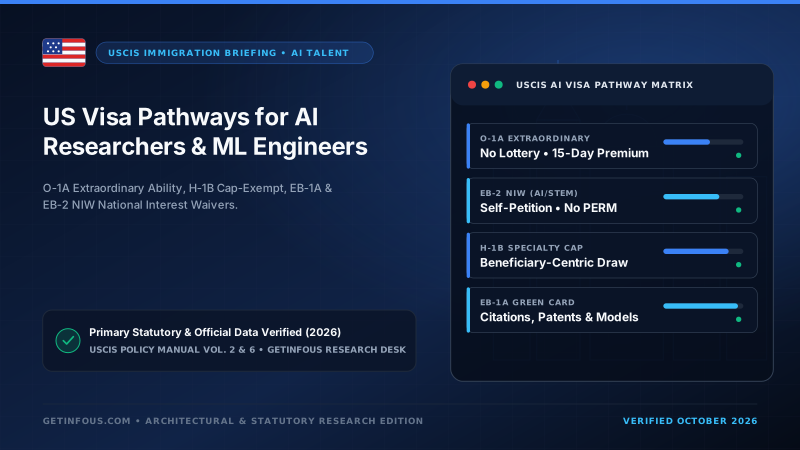
Yapay zeka uzmanları için ABD çalışma vizesi seçenekleri: kotasız O-1A olağanüstü yetenek vizesi, H-1B ve EB-2 NIW Green Card.
Bu sayfada
The Global Race for AI Talent and US Immigration
As artificial intelligence technology accelerates, United States Citizenship and Immigration Services (USCIS) has updated policy manuals to clarify evidentiary requirements for STEM professionals, with explicit emphasis on artificial intelligence and critical technologies.
Foreign AI specialists, PhD graduates, and experienced software engineers have several viable pathways to enter, work, and secure permanent residency in the United States.
1. O-1A Visa: The Uncapped Route for Exceptional AI Talent
The **O-1A nonimmigrant visa** is designed for individuals who possess extraordinary ability in the sciences, education, business, or athletics. Unlike the H-1B visa, the O-1A has **no annual numerical quota (no lottery)** and allows immediate filing throughout the year.
Key qualifying evidence for AI professionals includes:
- **Peer-Reviewed Publications & Citations:** Papers presented at top-tier AI conferences (e.g., NeurIPS, ICML, CVPR, ICLR, ACL).
- **Judging the Work of Peers:** Serving as a reviewer or program committee member for recognized machine learning venues.
- **Original Scientific Contributions:** Creation of widely used open-source libraries, novel model architectures, or patents that demonstrate major industry adoption.
- **Critical Employment Role:** Leading essential engineering initiatives at reputable tech enterprises or venture-backed startups.
- **High Compensation:** Remuneration significantly exceeding the median for computer scientists in the target metropolitan area.
2. H-1B Specialty Occupation Visa
The **H-1B visa** remains the most common corporate sponsorship mechanism for foreign professionals with at least a bachelor's degree or its equivalent in a related field (e.g., Computer Science, Data Science, Electrical Engineering).
Key factors for AI roles: - **Wage Level Requirements:** Tech employers must file a Labor Condition Application (LCA) certifying they will pay the prevailing wage determined by the US Department of Labor. - **Cap-Subject vs. Cap-Exempt:** Commercial tech companies must enter the annual spring lottery (capped at 65,000 standard plus 20,000 US advanced degree exemptions). However, universities, non-profit research institutes, and affiliated medical centers are cap-exempt and can hire AI researchers year-round.
3. Direct Green Card Routes: EB-1A and EB-2 NIW
Many AI researchers bypass employer sponsorship by self-petitioning for permanent residency:
- **EB-2 National Interest Waiver (NIW):** Foreign nationals with advanced degrees can obtain a green card without an employer sponsor if they prove their proposed AI research or technical endeavor has both substantial merit and national importance to the United States.
- **EB-1A Extraordinary Ability:** The permanent counterpart to the O-1A visa, granting direct green card status to top-tier international scientists.
Frequently Asked Questions
Can I qualify for an O-1A visa as an AI engineer without a PhD?
Yes. A PhD is not strictly required. High citations, significant contributions to open-source foundation models, lead architectural roles, or high-profile tech startup leadership can satisfy O-1A criteria.
Does USCIS provide special consideration for AI professionals?
Yes. USCIS guidance highlights critical and emerging technology fields (including AI), providing immigration officers with specific instructions on how to evaluate STEM achievements.
Benchmark scores, token prices, and rate limits evolve rapidly as AI labs release model updates. Always verify current specifications and pricing on the official provider documentation.
Explore Related Tech Guides
ABD’de Yapay Zeka Mühendisi Maaşları: Eyalet Bazında Ücret Rehberi (2026)
Amerika Birleşik Devletleri’nde yapay zeka ve makine öğrenimi mühendislerinin maaşları, hisse (RSU) paketleri ve teknoloji merkezleri rehberi.
Read full guide YZ Araçlarıİş Arayanlar İçin En İyi YZ Araçları: Özgeçmiş Optimizasyonu, Mülakat ve Vize Takibi (2026)
ATS filtreleri için özgeçmişinizi optimize etmenize, teknik mülakatlara hazırlanmanıza ve ABD vize sponsorluklarını takip etmenize yardımcı olan YZ araçları.
Read full guide