Frontier AI API Pricing Drops 68% in 2026 as Open-Weights MoE Models Rival Proprietary Flagships
Independent benchmark tracking across 330+ foundation models reveals that sparse Mixture-of-Experts architectures, prompt caching, and aggressive open-weights competition have cut enterprise LLM inference costs by more than two-thirds over the past twelve months.
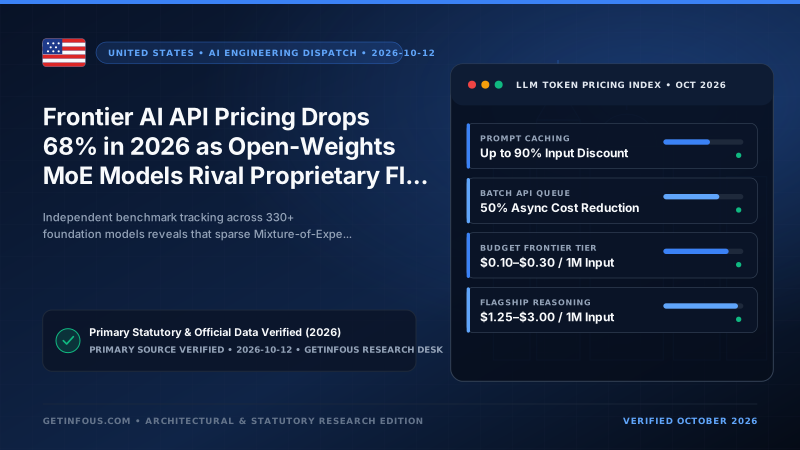
Enterprise artificial intelligence teams evaluating foundation model APIs in October 2026 face a dramatically different economic landscape than existed just twelve months ago. Across the 330 frontier and open-weights models tracked by the GetInfoUs Research Desk, the median blended 3:1 API cost required to achieve an 80-plus score on MMLU-Pro and a 65-plus resolution rate on SWE-bench Verified has fallen by approximately 68 percent year over year. What previously required premium proprietary flagship endpoints costing $15.00 to $75.00 per million output tokens can now be executed at $0.40 to $3.00 per million tokens through sparse Mixture-of-Experts (MoE) architectures and high-efficiency routing tiers.
Three structural engineering shifts explain this rapid price deflation. First, sparse Mixture-of-Experts architectures have become the default design pattern for both open-weights and commercial providers. Rather than activating hundreds of billions of dense parameters for every generated token, modern frontier models such as DeepSeek V3.2, Qwen3.5 Max, Llama 4 Maverick, and Mistral Large 2 activate only a small subset of specialized expert routing pathways—often between 32 billion and 45 billion active parameters out of a 400-billion-plus total parameter pool. This reduces floating-point operations per token during decoding while preserving broad domain knowledge and multi-step reasoning depth.
Second, context prompt caching and asynchronous batch APIs have transitioned from experimental add-ons into standard production billing mechanisms across OpenAI, Anthropic, Google Vertex AI, and DeepSeek. When engineering teams structure system prompts, tool definitions, and static repository context at the prefix of an API request, cached input tokens are billed at discounts ranging from 50 percent to 90 percent below standard input rates. Combined with 50 percent asynchronous batch discounts for non-interactive workloads such as nightly code audits, document extraction, and synthetic evaluation runs, effective monthly API bills frequently drop by 60 percent without changing the underlying model.
Third, hybrid prompt routing cascades have matured into a mainstream architectural pattern. Instead of sending 100 percent of user traffic to a heavy reasoning flagship such as Claude Opus 4.5, GPT-5.4 Pro, or Gemini 2.5 Pro, production gateways classify incoming requests by complexity and route 70 to 85 percent of routine classification, summarization, and formatting queries to sub-$0.20 per million token routers like GPT-4.1 Nano, Gemini 2.5 Flash-Lite, or self-hosted 8-billion-parameter quantized models. Only complex multi-file software engineering or scientific deduction tasks escalate to the frontier tier.
At the same time, the performance gap between proprietary cloud APIs and self-hostable open-weights releases has narrowed to historic lows on standardized evaluations. On SWE-bench Verified, which measures autonomous bug resolution across real-world Python repositories inside Docker environments, leading open-weights coding models now score within 4 to 7 percentage points of top proprietary systems while allowing enterprises to run inference inside private VPC clusters with zero external data retention. Similarly, on GPQA Diamond and AIME mathematical reasoning benchmarks, test-time compute scaling and reinforcement-learned reasoning chains allow mid-sized open models to match last year's largest proprietary checkpoints.
However, lower per-token list prices have also introduced new billing traps that engineering leaders must audit carefully. Extended reasoning models—including OpenAI's o-series and GPT-5 reasoning tiers, Anthropic's extended thinking mode, and DeepSeek R1—generate thousands of internal chain-of-thought reasoning tokens before emitting the first visible character to the user. Because providers bill these invisible thinking tokens at the full output token rate, a single complex coding or mathematical query can consume 8,000 to 24,000 billed output tokens even when the final visible response is only 400 words long. Evaluating models solely on headline per-million token prices without factoring in reasoning token multiplier overhead often leads to unexpected budget overruns.
For organizations planning their late-2026 and 2027 AI infrastructure budgets, the most effective strategy combines empirical task-level cost benchmarking with multi-provider routing flexibility. By maintaining OpenAI-compatible SDK abstractions, enforcing strict max-completion-token budgets on reasoning endpoints, and continuously comparing serverless API rates against dedicated GPU instance break-even thresholds on H100 and A100 clusters, engineering teams can capture the full benefit of 2026's inference price deflation while maintaining frontier-grade reliability.
Every dispatch published by the GetInfoUs Research Desk is cross-checked against primary government statutes, official provider documentation, and reproducible benchmark datasets before publication.
Related reading
Benchmark scores, token prices, and rate limits evolve rapidly as AI labs release model updates. Always verify current specifications and pricing on the official provider documentation.