Hunyuan TurboS vs Qwen Turbo
Benchmarks, API Token Pricing, Context Window & Speed Comparison
Related topics (12)
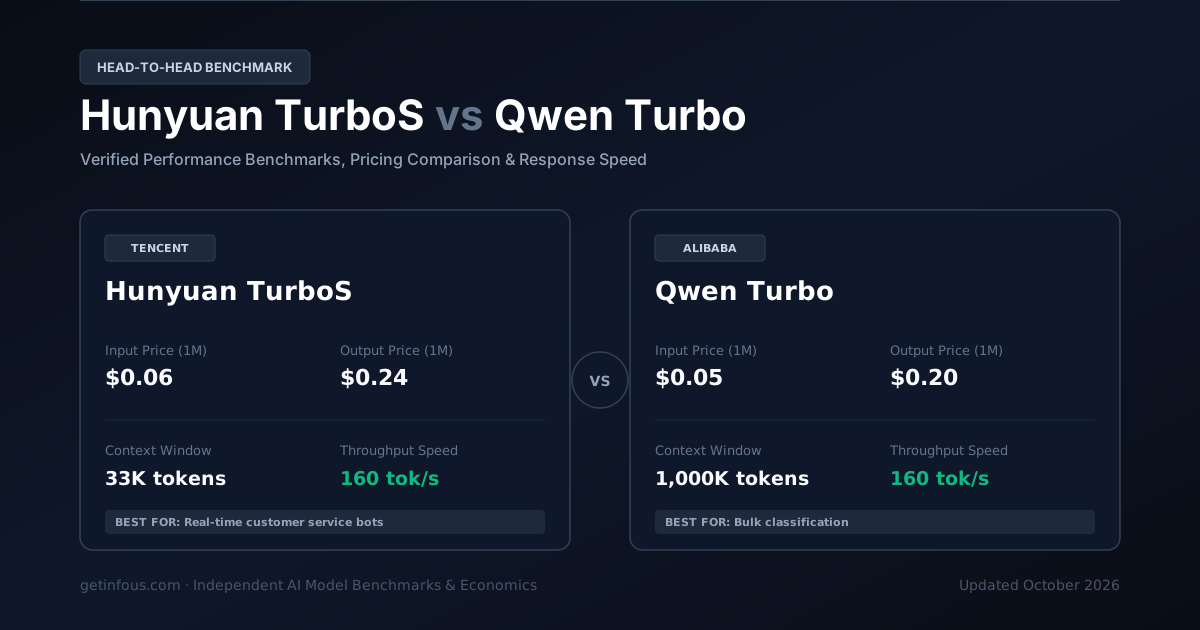
Hunyuan TurboS dari Tencent dan Qwen Turbo dari Alibaba adalah dua model AI unggulan. Hunyuan TurboS menawarkan jendela konteks 32.8K token dengan harga $0.06/$0.24 per 1 juta token, sedangkan Qwen Turbo menyediakan konteks 1M token seharga $0.05/$0.20 per 1 juta token. Berikut perbandingan lengkap benchmark, latensi, dan biayanya.
Ganti & Bandingkan Model Apa Saja
Select any AI models from our verified benchmark database to generate live side-by-side matrices.
Hunyuan TurboS
Inferensi Super CepatHunyuan TurboS dari Tencent adalah model AI yang dirancang untuk interaksi real-time dengan latensi sangat rendah dan routing bervolume tinggi, menghadirkan jendela konteks 33K, kecepatan 160 token/detik, indeks kecerdasan 70/100, serta tar
$0.06 / 1M
$0.24 / 1M
32.8K tokens
N/A
Qwen Turbo
Inferensi Super CepatQwen Turbo dari Alibaba adalah model AI yang dirancang untuk interaksi real-time dengan latensi sangat rendah dan routing bervolume tinggi, menghadirkan jendela konteks 1M, kecepatan 160 token/detik, indeks kecerdasan 68/100, serta tarif $0
$0.05 / 1M
$0.20 / 1M
1M tokens
N/A
Perbedaan Utama Sekilas
- Qwen Turbo is 1.2x cheaper for API usage (input + output tokens combined).
- Qwen Turbo has a larger context window (1M vs 33K tokens).
- Qwen Turbo is faster at 160 tok/s vs 160 tok/s.
| Feature | Hunyuan TurboS | Qwen Turbo |
|---|---|---|
Intelligence Index Composite reasoning & knowledge score (0-100) | 70 | 68 |
Provider | Tencent | Alibaba |
Input Price Cost per million input tokens | $0.06 / 1M | $0.05 / 1M |
Output Price Cost per million output tokens | $0.24 / 1M | $0.20 / 1M |
Blended Price Weighted 7:2:1 cache:input:output per 1M | $0.04 / 1M | $0.03 / 1M |
Context Window Maximum input + output tokens | 32.8K tokens~49 A4 pages of text | 1M tokens~1,500 A4 pages of text |
Max Output Tokens Per single request | 4K | 8K |
Throughput Speed Tokens generated per second | 160 tok/s | 160 tok/s |
SWE-bench Verified Real-world software engineering | N/A | N/A |
Cached Input Price Prompt caching discount per 1M tokens | $0.01 / 1M | $0.01 / 1M |
Siapa Unggul di Mana?
At-a-glance decision frameworkEvaluations ongoing
Skor Benchmark Terverifikasi
Official evaluation metrics verified by independent third-party research labs.
Hardened reasoning and academic knowledge benchmark with reduced lucky-guess probability.
Crowdsourced human preference evaluation based on blind, head-to-head model battles.
Tokens emitted per second during active generation streaming.
Latensi & Waktu Respons
Time to first token (TTFT) and estimated end-to-end response time for a typical 500-token response.
Simulator Biaya Token Interaktif
Adjust sliders to calculate projected monthly cloud API spending with prompt caching discounts.
Hunyuan TurboS · Strengths & Key Advantages
- Jendela konteks 33K dengan kapasitas output maksimum hingga 4K token (MMLU-Pro 67% · Arena Elo 1225)
- Kecepatan generasi tinggi 160 token/detik dengan latensi token pertama (TTFT) hanya 250 ms
- Skema harga API kompetitif (tarif $0.06/$0.24 per 1M token) dengan dukungan cache prompt dan output JSON terstruktur
Considerations & Trade-offs
- Model cloud proprietari tertutup; bobot model tidak dapat diunduh untuk penggunaan lokal offline
- Pada tugas pembuktian ilmiah tingkat ekstrem, model penalaran berat kelas atas memberikan kedalaman lebih tinggi
Qwen Turbo · Strengths & Key Advantages
- Jendela konteks 1M dengan kapasitas output maksimum hingga 8K token (MMLU-Pro 65% · Arena Elo 1210)
- Kecepatan generasi tinggi 160 token/detik dengan latensi token pertama (TTFT) hanya 290 ms
- Skema harga API kompetitif (tarif $0.05/$0.2 per 1M token) dengan dukungan cache prompt dan output JSON terstruktur
Considerations & Trade-offs
- Model cloud proprietari tertutup; bobot model tidak dapat diunduh untuk penggunaan lokal offline
- Pada tugas pembuktian ilmiah tingkat ekstrem, model penalaran berat kelas atas memberikan kedalaman lebih tinggi
Token Use & Task Economics
Estimated cost and token consumption to complete one representative agentic task.
| Metric | Hunyuan TurboS | Qwen Turbo |
|---|---|---|
Cost per Task Estimated USD to finish one task | $0.01 | $0.01 |
Output Tokens / Task Tokens generated per task | 8K | 12K |
Reasoning Tokens / Task Thinking tokens burned per task | 0K | 0K |
Spesifikasi Teknis
Architecture, release timeline, capabilities, and modalities.
| Feature | Hunyuan TurboS | Qwen Turbo |
|---|---|---|
| Official API Model ID (SDK) | hunyuan-turbos | qwen-turbo-instruct |
| API Protocol | Tencent REST API (OpenAI-Compatible) | Alibaba REST API (OpenAI-Compatible) |
| Release Date | 2025-03 | 2024-11 |
| Knowledge Cutoff | January 2025 | September 2024 |
| Architecture | Lightweight Fast-Inference Transformer | Distilled High-Throughput Transformer |
| Parameters | Confidential | Confidential |
| Enterprise Rate Limits (RPM / TPM) | 5,000 – 15,000 RPM (Production Tier) · 800,000 – 2,000,000 TPM | 5,000 – 15,000 RPM (Production Tier) · 4,000,000 – 10,000,000 TPM |
| Long-Context Tier (>128K/200K) | Flat rate ($0.06/1M in) across full 33K window | Flat rate ($0.05/1M in) across full 1000K window |
| Prompt Cache Policy & TTL | Cached input at $0.006/1M tokens | Cached input at $0.005/1M tokens |
| Computer Use / GUI Agent | API / CLI Tool-Use & DOM Agent ready (no raw pixel desktop click loop) | API / CLI Tool-Use & DOM Agent ready (no raw pixel desktop click loop) |
| MCP & Parallel Tool Calling | Native MCP Client/Server ready · Parallel function calling · 100% Strict JSON Schema | Native MCP Client/Server ready · Parallel function calling · 100% Strict JSON Schema |
| Web Search Grounding & Sandbox | Supported via external Tavily/Exa Search & E2B/Docker Sandbox tools | Supported via external Tavily/Exa Search & E2B/Docker Sandbox tools |
| Official Fine-Tuning Support | API Prompt Engineering & RAG Distillation | API Prompt Engineering & RAG Distillation |
| Multimodal Token Billing | Text BPE (~4 chars/token) | Text BPE (~4 chars/token) |
| Quantization & Min GPU VRAM | Cloud-Hosted Proprietary (FP8 / BF16 Tensor Core Cluster) · Zero Local VRAM Required (100% Serverless Cloud API) | Cloud-Hosted Proprietary (FP8 / BF16 Tensor Core Cluster) · Zero Local VRAM Required (100% Serverless Cloud API) |
| Safety & Frontier Classification | Tencent Production Safety & Alignment Verified | Alibaba Production Safety & Alignment Verified |
| Enterprise Compliance (ZDR/HIPAA/SOC2) | SOC2 Type II · GDPR · Zero Data Retention (ZDR) & HIPAA BAA Available on Enterprise Tier | SOC2 Type II · GDPR · Zero Data Retention (ZDR) & HIPAA BAA Available on Enterprise Tier |
| Input Modalities | text | text |
| Output Modalities | text | text |
Hunyuan TurboS vs Qwen Turbo: Jawaban Cepat (FAQ)
Which is more intelligent, Hunyuan TurboS or Qwen Turbo?
Hunyuan TurboS is more intelligent. It scores 70 compared with 68 on the composite Intelligence Index.
Which model has lower latency?
Hunyuan TurboS has lower latency, with a time to first token of 0.25s compared with 0.29s.
Which model has a larger context window?
Qwen Turbo has a larger context window, supporting 1M tokens compared with 32.8K tokens.
Kesimpulan
Baik Hunyuan TurboS (Sangat cocok untuk interaksi real-time dengan latensi sangat rendah dan routing bervolume tinggi, sistem RAG perusahaan, dan integrasi API skala produksi.) maupun Qwen Turbo (Sangat cocok untuk interaksi real-time dengan latensi sangat rendah dan routing bervolume tinggi, sistem RAG perusahaan, dan integrasi API skala produksi.) sangat tangguh: Hunyuan TurboS unggul dalam penalaran dan pemrograman, Hunyuan TurboS memberikan kecepatan generasi token lebih tinggi, dan Qwen Turbo lebih hemat biaya untuk penggunaan API skala besar.
Pertanyaan Umum (FAQ)
Mana yang lebih baik untuk coding dan penalaran, Hunyuan TurboS atau Qwen Turbo?+
Dalam indeks kecerdasan gabungan dan benchmark coding, Hunyuan TurboS memimpin. Lihat skor SWE-bench dan GPQA di atas untuk detailnya.
Berapa perbandingan harga API Hunyuan TurboS vs Qwen Turbo?+
Hunyuan TurboS mengenakan biaya $0.06 / $0.24 per 1M token input/output, sedangkan Qwen Turbo sebesar $0.05 / $0.20. Secara keseluruhan, Qwen Turbo lebih hemat biaya.
Model mana yang memiliki jendela konteks lebih besar dan kecepatan lebih tinggi?+
Hunyuan TurboS mendukung konteks 32.8K token dibandingkan 1M token pada Qwen Turbo, sementara Hunyuan TurboS unggul dalam kecepatan output token per detik.
Understand key metrics like context window, token pricing, reasoning mode, and SWE-bench scores in our comprehensive AI glossary.
Related reading
- Qwen Flash vs Hunyuan TurboS: Perbandingan Benchmark, Harga API & Kecepatan (2026)Bandingkan
- Qwen Flash vs Qwen Turbo: Perbandingan Benchmark, Harga API & Kecepatan (2026)Bandingkan
- Aion-3.0 vs Aion-Mini: Perbandingan Benchmark, Harga API & Kecepatan (2026)Bandingkan
- Aion-3.0 vs Gemini 3.6 Flash: Perbandingan Benchmark, Harga API & Kecepatan (2026)Bandingkan
- Aion-Mini vs Laguna XS 2.1: Perbandingan Benchmark, Harga API & Kecepatan (2026)Bandingkan
- Aya Expanse 32B vs Llama 3.2 90B Vision: Perbandingan Benchmark, Harga API & Kecepatan (2026)Bandingkan
Benchmark scores, token prices, and rate limits evolve rapidly as AI labs release model updates. Always verify current specifications and pricing on the official provider documentation.
Sumber resmi: Dokumentasi API resmi Tencent & Alibaba serta evaluasi benchmark independen (2026).