Kimi K2.5 vs MiniMax-M2.7
Benchmarks, API Token Pricing, Context Window & Speed Comparison
Related topics (12)
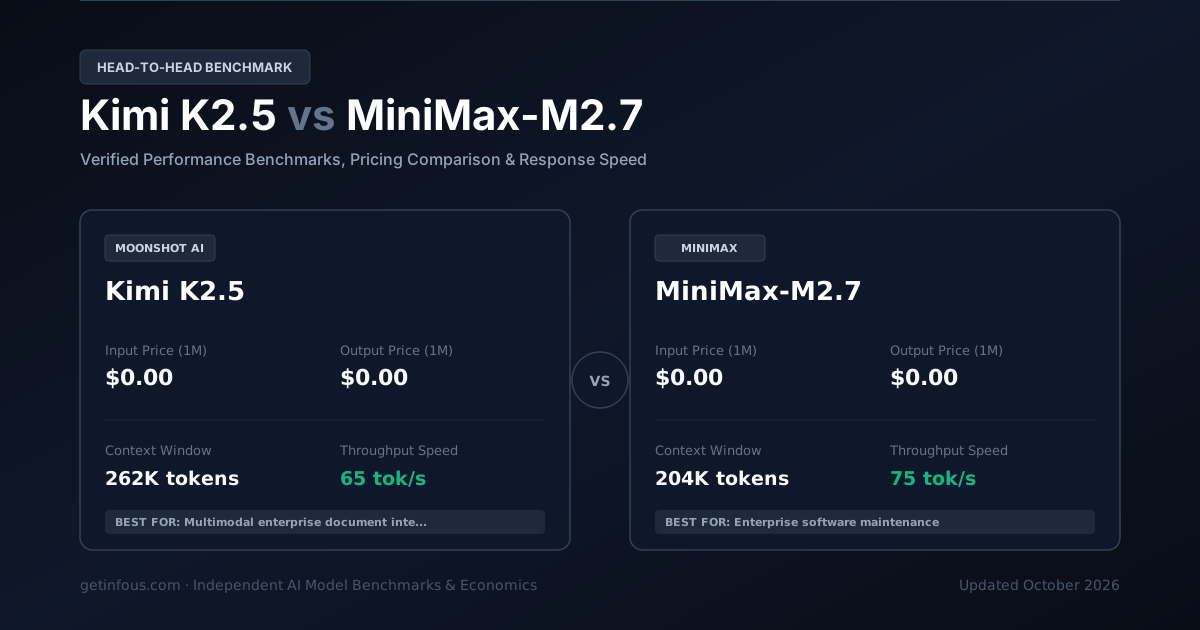
Kimi K2.5 by Moonshot AI and MiniMax-M2.7 by MiniMax represent two of the frontier AI models analyzed in our comprehensive 2026 AI benchmark and LLM comparison. In this head-to-head evaluation, we examine API token pricing, context window specifications, inference speed (tokens per second), and empirical reasoning performance. From a pure economic perspective, both models offer identical input token rates. On output generation, costs are matched. In data-heavy architectures requiring extensive repository or document analysis, Kimi K2.5 provides an expanded memory horizon with 262K tokens. In latency-sensitive production environments, MiniMax-M2.7 leads in tokens-per-second throughput, making it ideal for real-time conversational agents and high-concurrency workflows. Below is the complete empirical head-to-head breakdown across cost, speed, context, and capability matrices.
切换并对比任意模型
Select any AI models from our verified benchmark database to generate live side-by-side matrices.
Kimi K2.5
开源权重模型Moonshot AI 推出的 Kimi K2.5 人工智能模型,具备 262K 上下文窗口,输入价格为 $0/百万 Token,输出价格为 $0/百万 Token,专为高质量生产环境、推理与自动化工作流打造。
$0.00 / 1M
$0.00 / 1M
262.1K tokens
52%
MiniMax-M2.7
开源权重模型MiniMax 推出的 MiniMax-M2.7 人工智能模型,具备 204K 上下文窗口,输入价格为 $0/百万 Token,输出价格为 $0/百万 Token,专为高质量生产环境、推理与自动化工作流打造。
$0.00 / 1M
$0.00 / 1M
204K tokens
56%
核心差异一览
- Both models cost the same under this workload — choose on capability, not price.
- Kimi K2.5 has a larger context window (262K vs 204K tokens).
- MiniMax-M2.7 is faster at 75 tok/s vs 65 tok/s.
- MiniMax-M2.7 leads on SWE-bench coding (56.0% vs 52.0%).
| Feature | Kimi K2.5 | MiniMax-M2.7 |
|---|---|---|
Intelligence Index Composite reasoning & knowledge score (0-100) | 86 | 85 |
Provider | Moonshot AI | MiniMax |
Input Price Cost per million input tokens | $0.00 / 1M | $0.00 / 1M |
Output Price Cost per million output tokens | $0.00 / 1M | $0.00 / 1M |
Blended Price Weighted 7:2:1 cache:input:output per 1M | $0.00 / 1M | $0.00 / 1M |
Context Window Maximum input + output tokens | 262.1K tokens~393 A4 pages of text | 204K tokens~306 A4 pages of text |
Max Output Tokens Per single request | 16K | 16K |
Throughput Speed Tokens generated per second | 65 tok/s | 75 tok/s |
SWE-bench Verified Real-world software engineering | 52% | 56% |
GPQA Diamond Graduate-level reasoning | 69.5% | 67.5% |
各项指标谁更胜一筹?
At-a-glance decision framework权威基准测试得分对比
Official evaluation metrics verified by independent third-party research labs.
Industry benchmark evaluating real-world GitHub issue resolution and multi-file debugging.
Challenging questions created by domain experts to test complex PhD-level reasoning.
Hardened reasoning and academic knowledge benchmark with reduced lucky-guess probability.
Crowdsourced human preference evaluation based on blind, head-to-head model battles.
Tokens emitted per second during active generation streaming.
延迟与响应速度
Time to first token (TTFT) and estimated end-to-end response time for a typical 500-token response.
实时 Token 成本模拟器
Adjust sliders to calculate projected monthly cloud API spending with prompt caching discounts.
Kimi K2.5 · Strengths & Key Advantages
- 由 Moonshot AI 研发的高精度 Multimodal Open Mixture-of-Experts Transformer 架构,支持 262K 上下文窗口
- 极具竞争力的 API 定价(输入 $0/1M,输出 $0/1M),支持高速推理与工具调用
- 在代码生成、逻辑推理与多语言处理基准测试中表现出色
Considerations & Trade-offs
- 超长上下文请求需要规划 Token 成本与并发配额
- 针对特定垂直领域任务建议结合系统提示词与检索增强(RAG)以获得最佳效果
MiniMax-M2.7 · Strengths & Key Advantages
- 由 MiniMax 研发的高精度 Enterprise Open MoE Foundation Transformer 架构,支持 204K 上下文窗口
- 极具竞争力的 API 定价(输入 $0/1M,输出 $0/1M),支持高速推理与工具调用
- 在代码生成、逻辑推理与多语言处理基准测试中表现出色
Considerations & Trade-offs
- 超长上下文请求需要规划 Token 成本与并发配额
- 针对特定垂直领域任务建议结合系统提示词与检索增强(RAG)以获得最佳效果
Token Use & Task Economics
Estimated cost and token consumption to complete one representative agentic task.
| Metric | Kimi K2.5 | MiniMax-M2.7 |
|---|---|---|
Cost per Task Estimated USD to finish one task | $0.00 | $0.00 |
Output Tokens / Task Tokens generated per task | 24K | 22K |
Reasoning Tokens / Task Thinking tokens burned per task | 8K | 7K |
技术规格参数
Architecture, release timeline, capabilities, and modalities.
| Feature | Kimi K2.5 | MiniMax-M2.7 |
|---|---|---|
| Official API Model ID (SDK) | kimi-k2-5 | minimax-m2-7 |
| API Protocol | OpenAI-Compatible REST / vLLM / SGLang / HuggingFace TGI | OpenAI-Compatible REST / vLLM / SGLang / HuggingFace TGI |
| Release Date | 2026-01 | 2026-03 |
| Knowledge Cutoff | November 2025 | January 2026 |
| Architecture | Multimodal Open Mixture-of-Experts Transformer | Enterprise Open MoE Foundation Transformer |
| Parameters | 1.2T total (36B active MoE) | Confidential / 220B MoE |
| Enterprise Rate Limits (RPM / TPM) | Unlimited (Hardware-bound on self-hosted GPU) / 10,000 RPM Cloud · Unlimited local throughput / 10M+ TPM Managed Cloud | Unlimited (Hardware-bound on self-hosted GPU) / 10,000 RPM Cloud · Unlimited local throughput / 10M+ TPM Managed Cloud |
| Long-Context Tier (>128K/200K) | Free across full context window (only KV-cache VRAM scales) | Free across full context window (only KV-cache VRAM scales) |
| Prompt Cache Policy & TTL | Automatic prefix KV-caching in vLLM / SGLang (0 cost) | Automatic prefix KV-caching in vLLM / SGLang (0 cost) |
| Computer Use / GUI Agent | Supported (Screen coordinate grounding, browser & desktop GUI action loops) | API / CLI Tool-Use & DOM Agent ready (no raw pixel desktop click loop) |
| MCP & Parallel Tool Calling | Native MCP Client/Server ready · Parallel function calling · 100% Strict JSON Schema | Native MCP Client/Server ready · Parallel function calling · 100% Strict JSON Schema |
| Web Search Grounding & Sandbox | Supported via external Tavily/Exa Search & E2B/Docker Sandbox tools | Supported via external Tavily/Exa Search & E2B/Docker Sandbox tools |
| Official Fine-Tuning Support | Full Weights SFT, LoRA, QLoRA, DPO & GRPO RL (Unsloth / Axolotl / Llama-Factory) | Full Weights SFT, LoRA, QLoRA, DPO & GRPO RL (Unsloth / Axolotl / Llama-Factory) |
| Multimodal Token Billing | Text BPE (~4 chars/token) · Vision (~258–765 tokens per image tile) | Text BPE (~4 chars/token) |
| Quantization & Min GPU VRAM | BF16 / FP16, FP8 Dynamic, INT4 AWQ / GPTQ, GGUF (Q4_K_M / Q8_0) · 744 GB VRAM (4-bit Quantized) · 2580 GB VRAM (Native BF16) | BF16 / FP16, FP8 Dynamic, INT4 AWQ / GPTQ, GGUF (Q4_K_M / Q8_0) · 136 GB VRAM (4-bit Quantized) · 473 GB VRAM (Native BF16) |
| Safety & Frontier Classification | Open-Weights System Card + Customizable Guardrail Layer (Llama Guard / ShieldGemma) | Open-Weights System Card + Customizable Guardrail Layer (Llama Guard / ShieldGemma) |
| Enterprise Compliance (ZDR/HIPAA/SOC2) | 100% Air-Gapped On-Premises / Private VPC · Full HIPAA, GDPR & SOC2 Control | 100% Air-Gapped On-Premises / Private VPC · Full HIPAA, GDPR & SOC2 Control |
| Input Modalities | text, vision | text |
| Output Modalities | text | text |
Kimi K2.5 vs MiniMax-M2.7: 常见问题解答 (FAQ)
Which is more intelligent, Kimi K2.5 or MiniMax-M2.7?
Kimi K2.5 is more intelligent. It scores 86 compared with 85 on the composite Intelligence Index.
Which model is faster?
MiniMax-M2.7 is faster, generating 75 tokens per second compared with 65 tokens per second.
Which model has lower latency?
MiniMax-M2.7 has lower latency, with a time to first token of 0.51s compared with 0.62s.
Which model has a larger context window?
Kimi K2.5 has a larger context window, supporting 262.1K tokens compared with 204K tokens.
综合结论
Verdict & Model Selection Recommendation: Choose Kimi K2.5 if your priority is Multimodal enterprise document intelligence, visual bug fixing, and self-hosted agents. Its performance in demanding tasks justifies its operational token cost. Choose MiniMax-M2.7 if your workflow prioritizes Enterprise software maintenance, automated document workflows, and sovereign agents. For large-scale batch processing or customer-facing conversational interfaces, its balance of speed and economics delivers superior ROI.
常见问题 (FAQ)
How does Kimi K2.5 compare to MiniMax-M2.7 in API token pricing and cost per token?+
Both Kimi K2.5 and MiniMax-M2.7 are open-weights foundation models available at $0.00 direct API cost when self-hosted, or offered at identical baseline rates across major inference providers. Model selection depends on GPU deployment sizing and specialized benchmark performance rather than raw token price.
Which model has a larger context window: Kimi K2.5 or MiniMax-M2.7?+
Kimi K2.5 supports a context window of 262K tokens (~197k words), while MiniMax-M2.7 supports 204K tokens (~153k words). Therefore, Kimi K2.5 can process more textual data and document context in a single prompt.
Which AI model is better for software engineering and coding: Kimi K2.5 or MiniMax-M2.7?+
Kimi K2.5 scores 52% on SWE-bench Verified while MiniMax-M2.7 scores 56%. For autonomous software engineering and multi-file debugging, MiniMax-M2.7 holds the verified benchmark lead.
What is the difference in reasoning capability and extended thinking between Kimi K2.5 and MiniMax-M2.7?+
Kimi K2.5 features native chain-of-thought extended thinking mode with configurable reasoning effort. In contrast, MiniMax-M2.7 provides chain-of-thought reasoning depth for complex math and science.
How does inference speed (tokens per second) compare between Kimi K2.5 and MiniMax-M2.7?+
Kimi K2.5 generates approximately 65 tokens per second, while MiniMax-M2.7 delivers 75 tokens per second. In latency-sensitive production environments, MiniMax-M2.7 provides faster time-to-first-token (TTFT) and higher streaming response velocity.
Can you implement a tiered LLM routing setup combining Kimi K2.5 and MiniMax-M2.7 to optimize costs?+
Yes! Tiered multi-model routing can optimize for latency and accuracy: you can route high-frequency conversational turns and latency-sensitive queries to MiniMax-M2.7, and route deep architectural or complex reasoning queries to Kimi K2.5. This balanced routing strategy maximizes system throughput and answer quality.
Understand key metrics like context window, token pricing, reasoning mode, and SWE-bench scores in our comprehensive AI glossary.
Related reading
- Kimi K2.5 vs Kimi K2 Thinking: Benchmarks, Pricing & Speed Comparison对比
- Kimi K2.6 vs Kimi K2.5: Benchmarks, Pricing & Speed Comparison对比
- MiniMax-M2.7 vs MiniMax-M2.5: Benchmarks, Pricing & Speed Comparison对比
- MiniMax-M3 vs MiniMax-M2.7: Benchmarks, Pricing & Speed Comparison对比
- Aion-3.0 vs Aion-Mini: Benchmarks, Pricing & Speed Comparison对比
- Aion-3.0 vs Gemini 3.6 Flash: Benchmarks, Pricing & Speed Comparison对比
Benchmark scores, token prices, and rate limits evolve rapidly as AI labs release model updates. Always verify current specifications and pricing on the official provider documentation.
数据来源: GetInfoUs Independent AI Benchmarks & Official API Specs