Claude Opus 4.6 vs Claude Sonnet 4.6
Benchmarks, API Token Pricing, Context Window & Speed Comparison
Related topics (12)
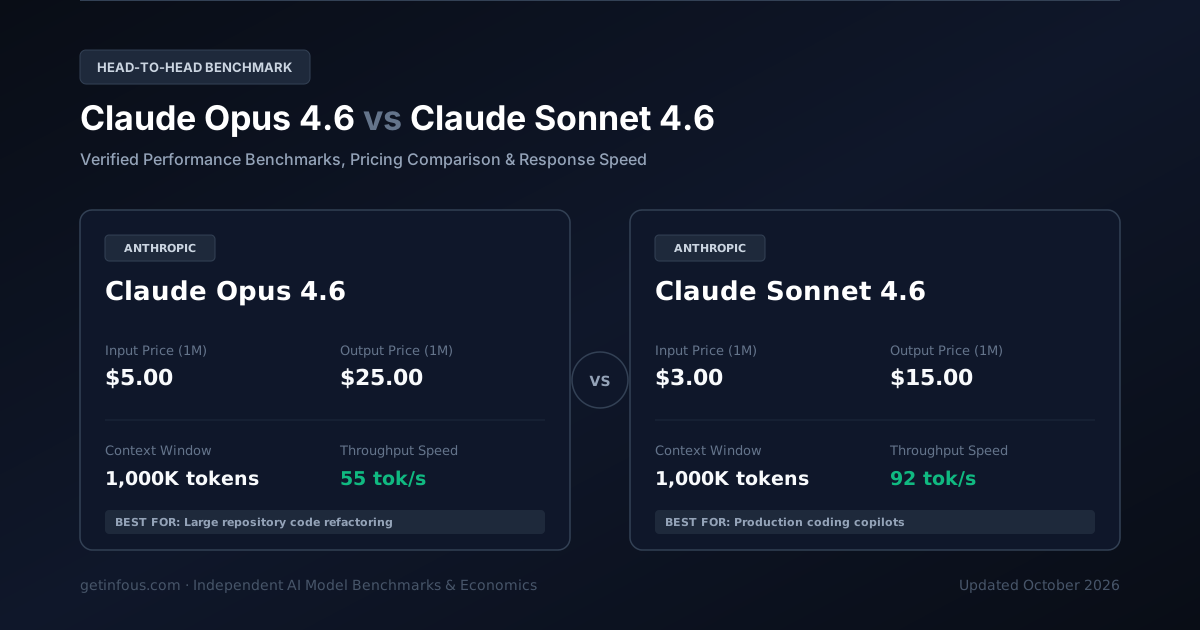
Claude Opus 4.6 by Anthropic and Claude Sonnet 4.6 by Anthropic represent two of the frontier AI models analyzed in our comprehensive 2026 AI benchmark and LLM comparison. In this head-to-head evaluation, we examine API token pricing, context window specifications, inference speed (tokens per second), and empirical reasoning performance. From a pure economic perspective, Claude Sonnet 4.6 holds a notable pricing advantage for token ingestion. On output generation, Claude Sonnet 4.6 is more economical per million generated tokens. In data-heavy architectures requiring extensive repository or document analysis, both models provide an identical memory horizon with 1,000K tokens. In latency-sensitive production environments, Claude Sonnet 4.6 leads in tokens-per-second throughput, making it ideal for real-time conversational agents and high-concurrency workflows. Below is the complete empirical head-to-head breakdown across cost, speed, context, and capability matrices.
切换并对比任意模型
Select any AI models from our verified benchmark database to generate live side-by-side matrices.
Claude Opus 4.6
深度推理模型Anthropic 推出的 Claude Opus 4.6 人工智能模型,具备 1M 上下文窗口,输入价格为 $5/百万 Token,输出价格为 $25/百万 Token,专为高质量生产环境、推理与自动化工作流打造。
$5.00 / 1M
$25.00 / 1M
1M tokens
78.4%
Claude Sonnet 4.6
深度推理模型Anthropic 推出的 Claude Sonnet 4.6 人工智能模型,具备 1M 上下文窗口,输入价格为 $3/百万 Token,输出价格为 $15/百万 Token,专为高质量生产环境、推理与自动化工作流打造。
$3.00 / 1M
$15.00 / 1M
1M tokens
76.1%
核心差异一览
- Claude Sonnet 4.6 is 1.7x cheaper for API usage (input + output tokens combined).
- Claude Sonnet 4.6 is faster at 92 tok/s vs 55 tok/s.
- Claude Opus 4.6 leads on SWE-bench coding (78.4% vs 76.1%).
| Feature | Claude Opus 4.6 | Claude Sonnet 4.6 |
|---|---|---|
Intelligence Index Composite reasoning & knowledge score (0-100) | 65 | 60 |
Provider | Anthropic | Anthropic |
Input Price Cost per million input tokens | $5.00 / 1M | $3.00 / 1M |
Output Price Cost per million output tokens | $25.00 / 1M | $15.00 / 1M |
Blended Price Weighted 7:2:1 cache:input:output per 1M | $3.85 / 1M | $2.31 / 1M |
Context Window Maximum input + output tokens | 1M tokens~1,500 A4 pages of text | 1M tokens~1,500 A4 pages of text |
Max Output Tokens Per single request | 128K | 128K |
Throughput Speed Tokens generated per second | 55 tok/s | 92 tok/s |
SWE-bench Verified Real-world software engineering | 78.4% | 76.1% |
GPQA Diamond Graduate-level reasoning | 76.5% | 74% |
Cached Input Price Prompt caching discount per 1M tokens | $0.50 / 1M | $0.30 / 1M |
各项指标谁更胜一筹?
At-a-glance decision framework权威基准测试得分对比
Official evaluation metrics verified by independent third-party research labs.
Industry benchmark evaluating real-world GitHub issue resolution and multi-file debugging.
Challenging questions created by domain experts to test complex PhD-level reasoning.
Hardened reasoning and academic knowledge benchmark with reduced lucky-guess probability.
Crowdsourced human preference evaluation based on blind, head-to-head model battles.
Autonomous multi-step tasks executed inside a real command-line terminal environment.
Tokens emitted per second during active generation streaming.
延迟与响应速度
Time to first token (TTFT) and estimated end-to-end response time for a typical 500-token response.
实时 Token 成本模拟器
Adjust sliders to calculate projected monthly cloud API spending with prompt caching discounts.
Claude Opus 4.6 · Strengths & Key Advantages
- 由 Anthropic 研发的高精度 Megacontext Frontier Reasoning Transformer 架构,支持 1M 上下文窗口
- 极具竞争力的 API 定价(输入 $5/1M,输出 $25/1M),支持高速推理与工具调用
- 在代码生成、逻辑推理与多语言处理基准测试中表现出色
Considerations & Trade-offs
- 超长上下文请求需要规划 Token 成本与并发配额
- 针对特定垂直领域任务建议结合系统提示词与检索增强(RAG)以获得最佳效果
Claude Sonnet 4.6 · Strengths & Key Advantages
- 由 Anthropic 研发的高精度 High-Throughput Multimodal Agent Transformer 架构,支持 1M 上下文窗口
- 极具竞争力的 API 定价(输入 $3/1M,输出 $15/1M),支持高速推理与工具调用
- 在代码生成、逻辑推理与多语言处理基准测试中表现出色
Considerations & Trade-offs
- 超长上下文请求需要规划 Token 成本与并发配额
- 针对特定垂直领域任务建议结合系统提示词与检索增强(RAG)以获得最佳效果
Token Use & Task Economics
Estimated cost and token consumption to complete one representative agentic task.
| Metric | Claude Opus 4.6 | Claude Sonnet 4.6 |
|---|---|---|
Cost per Task Estimated USD to finish one task | $5.49 | $3.29 |
Output Tokens / Task Tokens generated per task | 72K | 72K |
Reasoning Tokens / Task Thinking tokens burned per task | 37K | 37K |
技术规格参数
Architecture, release timeline, capabilities, and modalities.
| Feature | Claude Opus 4.6 | Claude Sonnet 4.6 |
|---|---|---|
| Official API Model ID (SDK) | claude-opus-4-6-20260201 | claude-sonnet-4-6-20260201 |
| API Protocol | Anthropic Messages API + AWS Bedrock + Vertex AI | Anthropic Messages API + AWS Bedrock + Vertex AI |
| Release Date | 2026-02 | 2026-02 |
| Knowledge Cutoff | December 2025 | December 2025 |
| Architecture | Megacontext Frontier Reasoning Transformer | High-Throughput Multimodal Agent Transformer |
| Parameters | Confidential | Confidential |
| Enterprise Rate Limits (RPM / TPM) | 4,000 – 10,000 RPM (Tier 4 + Priority Tier) · 4,000,000 – 10,000,000 TPM | 4,000 – 10,000 RPM (Tier 4 + Priority Tier) · 4,000,000 – 10,000,000 TPM |
| Long-Context Tier (>128K/200K) | Standard rate up to 200K tokens; 2x input/output tier above 200K tokens | Standard rate up to 200K tokens; 2x input/output tier above 200K tokens |
| Prompt Cache Policy & TTL | $0.5/1M cached read (90% off); 5-min default & 1-hour extended TTL | $0.3/1M cached read (90% off); 5-min default & 1-hour extended TTL |
| Computer Use / GUI Agent | Supported (Screen coordinate grounding, browser & desktop GUI action loops) | Supported (Screen coordinate grounding, browser & desktop GUI action loops) |
| MCP & Parallel Tool Calling | Native MCP Client/Server ready · Parallel function calling · 100% Strict JSON Schema | Native MCP Client/Server ready · Parallel function calling · 100% Strict JSON Schema |
| Web Search Grounding & Sandbox | Native Web Search Citations + Code Execution Tool + MCP Connectors | Native Web Search Citations + Code Execution Tool + MCP Connectors |
| Official Fine-Tuning Support | Custom Model Tuning via Amazon Bedrock & Prompt Distillation | Custom Model Tuning via Amazon Bedrock & Prompt Distillation |
| Multimodal Token Billing | Text BPE (~4 chars/token) · Vision (~258–765 tokens per image tile) | Text BPE (~4 chars/token) · Vision (~258–765 tokens per image tile) |
| Quantization & Min GPU VRAM | Cloud-Hosted Proprietary (FP8 / BF16 Tensor Core Cluster) · Zero Local VRAM Required (100% Serverless Cloud API) | Cloud-Hosted Proprietary (FP8 / BF16 Tensor Core Cluster) · Zero Local VRAM Required (100% Serverless Cloud API) |
| Safety & Frontier Classification | Anthropic RSP ASL-2 / ASL-3 Constitutional Safety Evaluated | Anthropic RSP ASL-2 / ASL-3 Constitutional Safety Evaluated |
| Enterprise Compliance (ZDR/HIPAA/SOC2) | SOC2 Type II · GDPR · Zero Data Retention (ZDR) & HIPAA BAA Available on Enterprise Tier | SOC2 Type II · GDPR · Zero Data Retention (ZDR) & HIPAA BAA Available on Enterprise Tier |
| Input Modalities | text, vision | text, vision |
| Output Modalities | text | text |
Claude Opus 4.6 vs Claude Sonnet 4.6: 常见问题解答 (FAQ)
Which is more intelligent, Claude Opus 4.6 or Claude Sonnet 4.6?
Claude Opus 4.6 is more intelligent. It scores 65 compared with 60 on the composite Intelligence Index.
Which model is faster?
Claude Sonnet 4.6 is faster, generating 92 tokens per second compared with 55 tokens per second.
Which model is cheaper to run?
Claude Sonnet 4.6 is cheaper at $2.31 per 1M tokens blended, compared with $3.85 (7:2:1 cache:input:output ratio).
Which model has lower latency?
Claude Sonnet 4.6 has lower latency, with a time to first token of 0.65s compared with 1.90s.
综合结论
Verdict & Model Selection Recommendation: Choose Claude Opus 4.6 if your priority is Large repository code refactoring, full-book technical translation, and enterprise legal discovery. Its performance in demanding tasks justifies its operational token cost. Choose Claude Sonnet 4.6 if your workflow prioritizes Production coding copilots, full-repo code search, customer agent workflows, and automated workflows. For large-scale batch processing or customer-facing conversational interfaces, its balance of speed and economics delivers superior ROI.
常见问题 (FAQ)
How does Claude Opus 4.6 compare to Claude Sonnet 4.6 in API token pricing and cost per token?+
Claude Opus 4.6 costs $5.00 per 1M input tokens and $25.00 per 1M output tokens, whereas Claude Sonnet 4.6 costs $3.00 input and $15.00 output. Overall, Claude Sonnet 4.6 is the more cost-effective model for high-volume API pipelines. Both models support prompt caching discounts of up to 90% for repeated prompt prefixes.
Which model has a larger context window: Claude Opus 4.6 or Claude Sonnet 4.6?+
Both Claude Opus 4.6 and Claude Sonnet 4.6 offer an identical context window of 1,000K tokens (~750k words). Both architectures provide equal capacity for large document ingestion, multi-file codebases, and extended multi-turn conversation histories.
Which AI model is better for software engineering and coding: Claude Opus 4.6 or Claude Sonnet 4.6?+
Claude Opus 4.6 scores 78.4% on SWE-bench Verified while Claude Sonnet 4.6 scores 76.1%. For autonomous software engineering and multi-file debugging, Claude Opus 4.6 holds the verified benchmark lead.
What is the difference in reasoning capability and extended thinking between Claude Opus 4.6 and Claude Sonnet 4.6?+
Claude Opus 4.6 features native chain-of-thought extended thinking mode with configurable reasoning effort. In contrast, Claude Sonnet 4.6 provides chain-of-thought reasoning depth for complex math and science.
How does inference speed (tokens per second) compare between Claude Opus 4.6 and Claude Sonnet 4.6?+
Claude Opus 4.6 generates approximately 55 tokens per second, while Claude Sonnet 4.6 delivers 92 tokens per second. In latency-sensitive production environments, Claude Sonnet 4.6 provides faster time-to-first-token (TTFT) and higher streaming response velocity.
Can you implement a tiered LLM routing setup combining Claude Opus 4.6 and Claude Sonnet 4.6 to optimize costs?+
Yes! High-efficiency architectures route high-frequency routine classification and conversational tasks to Claude Sonnet 4.6 to save operational costs, and dynamically escalate complex architectural queries or reasoning tasks to Claude Opus 4.6. This tiered routing pattern cuts overall API bills by up to 70%.
Understand key metrics like context window, token pricing, reasoning mode, and SWE-bench scores in our comprehensive AI glossary.
Related reading
- Claude Opus 4.6 vs Grok Build 0.1: Benchmarks, Pricing & Speed Comparison对比
- Claude Opus 4.7 vs Claude Opus 4.6: Benchmarks, Pricing & Speed Comparison对比
- Claude Sonnet 4.6 vs Claude Opus 4.5: Benchmarks, Pricing & Speed Comparison对比
- Claude Sonnet 4.6 vs Gemini 3.1 Flash-Lite: Benchmarks, Pricing & Speed Comparison对比
- Aion-3.0 vs Aion-Mini: Benchmarks, Pricing & Speed Comparison对比
- Aion-3.0 vs Gemini 3.6 Flash: Benchmarks, Pricing & Speed Comparison对比
Benchmark scores, token prices, and rate limits evolve rapidly as AI labs release model updates. Always verify current specifications and pricing on the official provider documentation.
数据来源: GetInfoUs Independent AI Benchmarks & Official API Specs